.
My God yes, this is England: not the only England, but one England among many. It is certainly an England I have lived in.
What Shane Meadows does brilliantly is capture and express a specific time and place, and root his story in the real experiences of working class life. Skinheads rejoiced in how the English often see ourselves, as hard drinkers and fighters, brave men who “can meet with Triumph and Disaster, and treat those two impostors just the same.” It was a youth sub-culture born of cultural impoverishment, but also rebellious, exuberant and cheeky. Being a skinhead meant being part of a gang that approved of you, and the values of being a skinhead were generally ones celebrated in English culture (I am not saying that is a good thing!) This is underlined by the frequent references to the Falklands war.
Thomas Turgoose turns in a fantastic performance as Shaun, the troubled 12 year old brought into a local gang of skinheads, attracted by their camaraderie, and the way they boost his self esteem. What the film does very well is show how precarious and out of control life is when you are young, as the gang changes around Turgoose’s character, and the bond of loyalty to the gang becomes more sinister and explicitly racist.
Stephen Graham as Combo, the racist skin just out of nick is electrifying. The review in the Guardian described Combo as “deeply objectionable”, but that soooh misses the point. The truth is that anyone who has ever been in a youth sub-culture has had mates like Combo. Older men who, like Peter Pan, shelter from life’s disappointments by being the respected elder in the gang. He is objectionable from the point of view of a Guardian journalist, but from the point of view of a 12 year old on a council estate, Combo is quite glamorous.
The contradiction that Combo was both a violent racist, but also conscious of the multi-racial origins of Skin culture was convincing. Back in the 1970s I had friends very sympathetic to the NF who would listen to ska music, and thought Desmond Dekker was like unto a God. This is part of a very contradictory world view that understands class grievances, but articulates them through racism. So there is an ambivalence about black people who share the same class experience.
Indeed, in the late 1970s and early 1980s most (white) working class teenagers knew people in the NF. I found the NF meeting in a tatty pub completed convincing, and I liked the way the film showed the NF as reasonably attractive for these alienated lads, while at the same time most of the skins saw through it as a pile of shit.
There are some lovely touches in the film. The fact that combo only has a provisional driving licence is comically deflating in an understated way, and the indignity for Shaun, that DMs don’t come in children’s sizes!
There were some things I was not too sure about. I think the film tried too hard to explain why Combo was a loser, whereas I think the audience could have been trusted to work that out without the Oprah moments. I am also not entirely sure that skins in 1983 were listening to ska so much , as opposed to the Cockney Rejects and Angelic Upstarts. There was also a political problem, that in 1983 the NF would not have been talking about Englishness, but Britishness, and it would have been the Union Jack, not the Cross of St George behind the NF speaker.
But generally, this is a great, and very English, film.
Showing posts with label Identity. Show all posts
Showing posts with label Identity. Show all posts
Tuesday, May 29, 2007


Tuesday, March 20, 2007
SOAS: Feminism, cultural relativism, academia and activism

“No one today is purely one thing. Labels like Indian or Canadian or woman or Muslim or American are no more than starting points which, if followed into actual experience for only a moment, are completely left behind. Imperialism consolidated the mixture of cultures and identities on a world scale. But its worst and most paradoxical gift was to allow people to believe that they were only, mainly, exclusively white or black or Western or Oriental”. (Edward Said)
I attended a meeting on Feminism, Cultural Relativism, Academia and Activism at SOAS today. The room was packed with mainly young women with a couple of young blokes.
First speaker was Dr Laleh Khalili who is in the process of writing a book on colonial prisons. She has written about the experiences of Palestinian refugees in Lebanon that she visited in Nov 2001. She spoke about the anxiety and worry experienced by the refugees about imminent attacks by the West in reprisals for 9/11. As a researcher she was aware of how she was influencing the people she had met at the camps. She identifies herself as an Iranian woman who lives in the West with Eurocentric views. She argued that multiples identities play a significant role within the boundaries of the public domain and private sphere which are power laden social constructs.
The space between the personal and the political are fake barriers. When she visited the camps she explained about her Iranian background but veiled instead her American background. Personal history can open or close doors. She also saw herself as an affluent Western Iranian in a position of power and how this impacted on the people she was working with. She saw multiple identities such as being Iranian, American, Western and a woman and how this impacts on her work. She said feminism is relevant as it explains where you stand as a woman. And also other power relationships are woven in such as race, religion, sexuality.
I think what struck me listening to Laleh was the old slogan, “personal is the political” from the woman’s liberation campaign embedded in her talk and that it is still as important today.
Elaheh Rostami Povey spoke first about the academic Stuart Hall and how he defined his own Black identity. How identity is very complex. It also reminded me of the psychiatrist Frantz Fanon when he, living in French Martinique, saw himself as French yet when he moved to France was seen as “inferior” and not at all equal. After 9/11 Elaheh reclaimed her Muslim identity even though she is a secular Iranian. She identified with Muslims as a reaction to racism. She spoke about how she saw feminism as a “good ideology” though she has “mellowed in her old age”! She dislikes the term “gender studies” in academia as she believes it is an excuse not to talk about women.
Most of her academic work has been set in Iran and Afghanistan. She interviewed women in Iran during the early 1990s. Her hypothesis was that women were marginalised because of Islam and economic contribution was negligible. She found the opposite. Iranian society opened up opportunities for women in theocracy. Around 64% of university students are women.
She also spoke about how strong the fight for women’s rights in civil society. Muslim feminists argue that Islam is not repressive to women but the male interpretation of the readings of the Koran. The women’s movement in Iran has pushed for reforms. One successful reform is that women with foreign husbands can now pass their citizenship to their children (Egypt is the only other Muslim country to do this).
Anti-imperialist women are at the forefront of the democracy movement in Iran. Thirty women were arrested this month for protesting and showing solidarity with four other women who have gone on trial for organising a protest last summer. According to Povey they should be released within the next couple of days. She argued that any attack by imperialist forces on Iran will destroy the gains women have made.
Many of these women describe themselves as feminists and have been influenced by western feminism but have, correctly critiqued the limitations of Eurocentric feminism.
She then spoke about her interviews with Afghan women in Afghanistan, USA and UK. She found that before the invasion women felt better equipped to fight for rights and met little resistance from men. The occupation symbolises western culture to these women. In the USA and UK women have found it harder to challenge inequalities because they don’t want to break ranks and the bigger picture being racism. In her final bit of her speech she quoted Edward Said who described the “superior western culture” and the inferior “other” culture such as Islam.
Finally Lynn Welchman spoke about bridging the gap between academia and activism. She briefly discussed her book, “Honour: Crimes, Paradigms and Violence against Women” (written jointly with Sara Hossain). She discussed the importance of alliances and letting people speak for themselves as opposed to someone speaking for them. She spoke about the rejection of blaming it on “culture” (“white women and men saving brown women from brown men”.) and how this has its own echoes in colonialism.
There was a brief question and answer session towards the end. All three spoke about the importance of feminism and how it has had an enormous influence on their consciousness. The need, as well, to strip away those identities along with the conflicts, the contradictions, privileges and the power. Incidentally, Laleh Khalili said she asked students in her class if any of them were feminists (this was around 3 years ago) and only one said yes. She found that depressing.
The chair asked the women in the room to put up your hand if you described yourself as a feminist. All the women in the room did (including myself...).
I am still digesting everything I heard and was interested in what the speakers said about identity and how we unravel those multiple identities as social constructs (I have been reading about this in Lynne Segal’s latest book, Making Trouble). And how we perceive ourselves along with others. The other interesting issue is about letting people speak for themselves which to me is really about self-determination.
(The picture is of an oil painting by Arab woman artist, Fatima Abu Roomi, entitled "Fatima")
Monday, October 02, 2006
A nation once again?
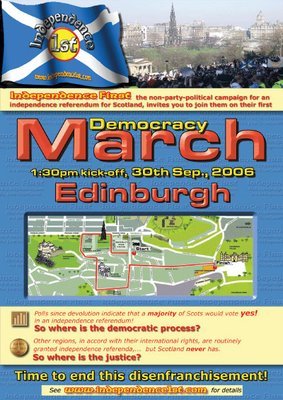
There is a very interesting report on Kevin Williamson’s blog about the march in Edinburgh last Saturday in support of Independence. It includes a You Tube video of the demonstration. Note in addition to the SSP banners and placards a big “Solidarity” banner.
It is worth reading the important article by Murray Smith on the National Question in western Europe, where he explains why support for independence is not nationalist:
“The support for Scottish independence seems to be stronger rather than weaker, the difference being that no one party can any longer claim to be the sole representative of independence. In Wales, the leadership of Plaid Cymru was always a bit bashful about independence, resorting to circumlocutions like 'full national status'. But after the setbacks the party experienced in the May elections a new leadership has taken over and the recent conference of the party came out massively and noisily for independence. At the same time Plaid denounced Labour for having abandoned "all its old socialist values in favour of creeping privatisation".
"There are certainly reasons inherent in the Welsh situation which help to explain this evolution, in particular the shift to the left of the Welsh Labour Party. But if the support for independence is stronger and Plaid has moved to the left it is also because of the example of Scotland, where the situation is more advanced. And in coming out clearly for independence and taking up a position to the left of Labour, Plaid is following the example of the SSP rather than the SNP, which is now abandoning such a position in favour of neoliberal policies.
"The question that is posed, and posed very concretely in Scotland at the moment, is not just the issue of independence, but of what independence. It is posed for those who are already in favour of independence, but it is also vital for winning over those who are not yet convinced. It is worth recalling at this point that 'independence /national movement' does not equal 'nationalism'. That would be to confuse a political objective with an ideology. Miroslav Hroch explains: "the current tendency to speak of them (national movements, MS) as 'nationalist' leads to serious confusion. Because nationalism in the strict sense is something else: namely, that outlook which gives an absolute priority to the values of the nation over all other values and interests" (emphasis in the original)
"Independence is always concrete. It leads to the creation of states and states have a class character. That is why it is when independence becomes a real possibility that national movements begin to crystallise into different currents, as is happening in Scotland today. The SNP is a nationalist party, which is furthermore in the process of seriously watering down its commitment to independence, in the framework of its rightward evolution. The SSP is a party that rejects nationalist ideology, which is internationalist but which aims to be the best fighter for Scottish independence, while giving that independence a socialist content. It is from this position of strength that the SSP can support the idea of a pole for independence in the shape of the Independence Convention, which will put the SNP leadership in contradiction with part of its own supporters."
Subscribe to:
Posts (Atom)
