In case you are wondering, the last post on Somalia, sent all the links down to the bottom of the page. I have tried changing font size, and deleting the picture, etc. But can't sort it out.
Something about that posting has buggered up the page format.
Wednesday, July 12, 2006


Socialist Worker on Somalia

Here is a curious thing. Let us look at two reports about the take over in Somalia by the Union of Islamic Courts. One report from the Integrated Regional Information Networks (IRIN) which is an agency of the United Nations Office for the Coordination of Humanitarian Affairs; and one report from our favourite tabloid Socialist Worker.
From UN Agency the IRIN we read: “The takeover of Mogadishu on 4 June by the Union of Islamic Courts (UIC) was the most important political event in Somalia in the last 16 years.
It removed a political class of clan-based extortionists and dealers in everything from drugs to people, known as ‘warlords’, which has divided and ruled the country since the collapse of the central state in 1991. Warlordism created one of the world’s most protracted humanitarian crises. In the absence of any significant political, military or humanitarian intervention, Somalia has suffered chronic impoverishment, exodus, displacement and international isolation.
"However, the recent military victory by UIC, triggered by popular revolt against the warlords, achieved what international military intervention and peace talks have failed to accomplish since 1991. Unable to neutralise or control the warlords, the international community ultimately resorted to working with them.”
From Socialist Worker we read: “The takeover of the capital, Mogadishu, on 4 June by the Union of Islamic Courts (UIC) removed a political class of clan-based extortionists and dealers in everything from drugs to people, known as “warlords”. They have divided and ruled the country since the collapse of the central state in 1991.
"The UIC’s military victory, triggered by popular revolt against the warlords, achieved what international military intervention and peace talks have failed to accomplish since 1991.
Unable to neutralise or control the warlords, the Western powers ultimately resorted to working with them. ”
From UN agency the IRIN we read: “Key to the success of the UIC was the fact that it was already an established and accepted presence in local communities, with a demonstrated social welfare policy.
"Apart from bringing security to areas under its control, through its own militia and justice system, it had also set up farms, schools, water points, health clinics and orphanages.
"Although the UIC did not initially have strong popular support, there was a feeling that it upheld moral standards and discipline, and had a unifying and familiar ideology in Islam.”
From Socialist Worker we read: “Key to the military success of the UIC was the fact that it was already an established and accepted presence in local communities, with a demonstrated social welfare policy.
"Apart from bringing security to areas under its control, through its own militia and justice system, it had also set up farms, schools, water points, health clinics and orphanages. Some key businessmen in Mogadishu worked with the Courts.
"Although the UIC did not initially have strong popular support – some were suspicious of its agenda – there was a feeling that it upheld moral standards and discipline and had a uniting and familiar ideology in Islam.”
But the conclusions are different. From UN agency the IRIN we read “In his conversation with chairman Sheikh Sharif, the UN Special Representative stressed the need to respect the ceasefire and to maintain a dialogue.
"He said the chairman had expressed his willingness to work with all parties interested in promoting peace in Somalia. “Dialogue is part of the culture of the Somali people.
I am hopeful that whatever differences exist among the Somalis today can be resolved peacefully. The UN stands ready to assist the peace process in any way possible," he said.”
From Socialist Worker we read the rather different spin; “there is no doubt imperialism has suffered a blow”
It is hard to understand this conclusion, there is nothing inherently anti-imperialist about the UIC, any more than the Taliban were anti-imperialist, who after all came to power helped by the Pakistani secret service.
There is no notification in the Socialist Worker article that most of it is lifted straight from an official UN web-site, but it does say: “© Copyright Socialist Worker (unless otherwise stated). You may republish if you include an active link to the original and leave this notice in place”
Tuesday, July 11, 2006
solitudinem faciunt, pacem appellant
"They made a desert and called it peace" Tacitus, from "Agricola"

A recent report by Human Rights Watch spells out a desperate situation for education in Afghanistan. “Schools are being shut down by bombs and threats, denying another generation of Afghan girls an education and the chance for a better life. Human Rights Watch found entire districts in Afghanistan where attacks had closed all schools and driven out the teachers and non-governmental organizations providing education. Insecurity, societal resistance in some quarters to equal access to education for girls, and a lack of resources mean that, despite advances in recent years, the majority of girls in the country remain out of school. Nearly one-third of districts have no girls’ schools. ”
According to HRW: “The Taliban and allied groups, such as warlord Gulbuddin Hekmatyar’s Hezb-e Islami, were responsible for many, but not all, of the attacks on schools and teachers. In other instances, local warlords have carried out such attacks to strengthen their local control. Afghanistan’s rapidly growing criminal networks, many involved in the production and trade of narcotics, also target schools because in many areas they are the only symbol of government authority. "
It is important to note that following the fall of the central Taliban government, the US occupiers deliberately undermined the possibility of a stable replacement government by forming alliances with local warlords, often returning to power narcotics gangsters who the Taliban had driven out, such as Gul Aga in Herat. The security vacuum can be understood by comparing the fact that Afghanistan has one policeman for every 1500 people, only one third the proportion of police in law-abiding Switzerland.
Human Rights watch has described the atrocities: "committed by gunmen and warlords who were propelled into power by the United States and its coalition partners after the Taliban fell in 2001" and who have "essentially hijacked the country". The report describes army and police troops controlled by the warlords kidnapping villagers with impunity and holding them for ransom in unofficial prisons; the widespread rape of women, girls and boys; routine extortion, robbery and arbitrary murder
It is important to remember that the invasion of Afghanistan was carried out on the obscene lie that the Taliban were protecting Bin Laden, even after the government of Mullah Omar had agreed to extradite Bin laden . It is also important to remember that the degeneration of Afghanistan did not occur during the Russian military presence, but in an orgy of destruction by the American backed war lords after the Russians left in 1989, killing more than 50000 in just one year. It was this barbarism that produced the obscurantist Taliban, who managed briefly to impose some stability, but on a society already brutalised.
New Labour politicians spun their webs of deceit to make the invasion seem like a humanitarian intervention, ignoring the proposed extradition of Bin laden that made the excuse for the war hollow. Ignoring the actual track record of the Americans in promoting the killing fields of Afghanistan during the 1990s, New Labour promised that the war would lead to reconstruction. What shabby lies, what betrayal. Nearly five years on, Afghanistan is a post apocalyptic land, the people of Afghanistan, most tragically the women, sacrificed to the sordid ambitions of Tony Blair, who wanted his place in History.
14 October 2001 - John Prescott, the Deputy Prime Minister, said that Britain was determined to "win the peace" in Afghanistan through a massive aid effort and the creation of a democratic, post-Taliban government. Mr Prescott, who was in Moscow for talks on terrorism and the environment, called for the international coalition to be turned into a wider campaign against global poverty once the conflict was over.
05 October 2001 - Jack Straw sent a direct message to the people of Afghanistan promising help from the outside world once the Taliban were overthrown and Osama bin Laden faced justice. In a text broadcast on the BBC World Service, the Foreign Secretary promised generous assistance to provide schools, clinics, roads and secure livelihoods in the future. He said: "Our commitment to the Afghan people is simple and sincere. You have been ill-served by those who made your country a haven for terrorists across the world. … As soon as this stops, the world will work with you to build a better future for you and for your children."
06 October 2001 - Peter Hain "Let's use this great coalition to fight world poverty. The solidarity shown to the US could promote an end to unilateralism and isolationism. The international community must work together to minimise the suffering of the Afghan people and to ensure them a peaceful, stable and free future in their country. That means helping to rebuild Afghanistan after its terrorist bases have been eliminated, not just with food aid but with development assistance for infrastructure, jobs, hospitals, schools and homes."
02 October 2001 - Tony Blair "With every bit as much thought and planning, we will assemble a humanitarian coalition alongside the military coalition "
But in reality, five years after these promises were made, the UN World Food Programme reports that: “over 50 percent of children are malnourished in Afghanistan, while one in three of people living in rural areas are unable to meet daily basic nutritional requirements.”
Monday, July 10, 2006
Water privatisation a disaster in Senegal

Water privatisation has been a disaster in Britain, as infrastructure repairs to fix leaks are given lower priority than shareholders dividends. But this is in affluent Britain. How has water privatisation worked elsewhere?
During the 1980s, the Senegelese government of Abdou Diouf, followed the structural adjustment programmes dictated by the World bank. This fanaticism for privatization reached into even the most strategic state enterprises,and Senegal’s state water company SONES was broken into two and sold off. In the words of African journalist, Hawa Ba,: “Privatisation, it was said, would be the solution to the well-known dysfunctionality of the sector which was unable to meet populations’ growing needs. But instead of addressing the many well-reported barriers to access to water and electricity, these privatisations only served to render more precarious the position of the most disadvantaged in society. Access to water and to electricity has become more chancy, exacerbated by exorbitant rising costs … … “liberalisation” and “privatisation” fetishised language littered the discourse of decision-makers while at the same time creating a living death for whole populations.”
This is what happened when water was privatized:
Water inequality has increased, with supplies to rural areas being allowed to decline. The state has therefore encouraged discrimination against parts of its own population based upon what was most profitable and conveneient for a private multinational.
Communal fountains under local democratic control that provided free clean water to households, schools and communal facilities have been shut. As a result there was a decline in the use of water for domestic hygiene, and a rise in cholera in Senegal. The communal fountains also played an important social role, and this has been lost.
Schools often have no water now, and children are sent to local houses to get drinks or wash, exposing them to danger, including sexual abuse.
Only 60000 new connections have been made in 6 years, out of a potential of 10 million.
Water quality has declined so that people no longer have confidence that it is safe to drink, and bottled water is now preferred for drinking. Water supplies are frequently cut off for hours or days at a time.
Prices have gone through the roof, with a 40% increase in 2003 alone!
Even the World bank admits that the business model has been a failure, as private companies have no incentive for providing water to poor rural areas. But their remedy, is even more privatisation and competition, not for the water supplied to be returned to public ownership.
But there is another way. We are fortunate at the moment that Oscar Olivera, who led the revolt against water privatisation in Bolivia in 2000 is on tour in Britain. The revolt prevented the sale of Cochabamba’s water to Bechtel. The tour details can be found here.
Sunday, July 09, 2006
Defend the Right to Strike
Please send a message of support to 107 members of the Australian union, the Construction, Forestry, Mining and Energy Union (CFMEU) who are facing huge fines or gaol terms for going on strike. Their email contact is jmellor@cfmeuwa.com
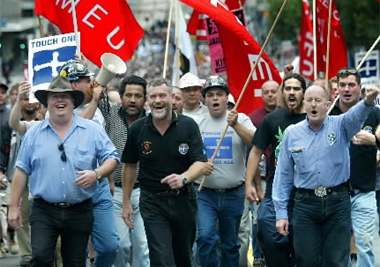
The 107 workers, who are employed on the Mandurah to Perth Rail line are facing fines of up to $22,000 each (£8900), simply for taking industrial action last February. This move opens a new era on industrial relations in Australia, after the new building industry watchdog, an Australian Building and Construction Commission (ABCC), lodged writs in the federal court. The court action is one of the first uses of the savage Industrial Relations legislation recently introduced by John Howard's government, and which saw hundreds of thousands of Australian trade unions take to the streets last year.
Tory prime minister, John Howard, is the most junior partner in the Bush, Blair, Howard alliance who invaded Iraq, and there is clearly a flow of ideas between the three governments. But Australia is also a major regional power, and an important economy in its own right.
The original industrial action was to get their union delegate, Peter Ballard, his job back. Ballard was sacked for seeking to enforce already agreed health and safety conditions. Eighty-two of the 107 face additional fines of $6600(£2700) each.
The charges were made on June 5, follow months of harassment and intimidation of workers involved in the dispute, including interrogations by the ABCC. The remaining 296 workers who stopped work in February still face the prospect of being charged. Since its formation last year, the ABCC has been targeting workers and unions who have taken industrial action over occupational health and safety concerns, in particular, including life-threatening workplace issues.
According to a report in the newspaper, The West Australian, The legal action stems from the workers' 12-day strike, which Contractor Leighton Kumagai said cost it $200,000 a day. The Mandurah railway has at times been paralysed by industrial action, which is partly to blame for the project now running five months behind schedule and forms part of the $200 million in cost overrun claims from Leighton Kumagai against the State Government.
Construction, Forestry, Mining and Energy Union secretary Kevin Reynolds warned in June last year that the project would be targeted by unions to defend trade union organisation in the construction industry, after some contracts were awarded to a non-unionised firm. Work on the project had also been subject to imaginative unofficial action, so-called "blue-flu" days, where several workers take sick leave at the same time.
Make no mistake, if John Howard's government gets away with criminalising basic trade union activity, then that message will be picked up loud and clear by New Labour here in the UK.
Friday, July 07, 2006
Favourite leftie films
Over the last two or three year’s Swindon Socialist Alliance have had a irregular film night in a local pub. This has been reasonably successful, with us getting more than 70 people to a showing of Michael Moore’s “Roger and Me” for example, and excellent turn outs for documentaries about Argentina, Venezuela and Palestine.
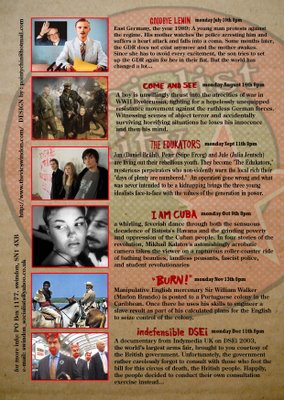 So now we have decided to get a bit more professional, book a series of 6 films in advance, and we have produced 2000 glossy postcards to advertise them.

The next 6 films we are showing are:
Goodbye Lenin
Come and See (Russian film about WW2)
The Edukators
Soy Cuba (Classic 1964 documentary)
Burn! (Marlon Brando film about 19th century slave revolt)
Indefensible DSEi (Indymedia documentary about anti-arms trade protests)
What do you think are the best films for socialists to show, and why?
So now we have decided to get a bit more professional, book a series of 6 films in advance, and we have produced 2000 glossy postcards to advertise them.
The next 6 films we are showing are:
Goodbye Lenin
Come and See (Russian film about WW2)
The Edukators
Soy Cuba (Classic 1964 documentary)
Burn! (Marlon Brando film about 19th century slave revolt)
Indefensible DSEi (Indymedia documentary about anti-arms trade protests)
What do you think are the best films for socialists to show, and why?
Labour NEC elections

Ballot papers have now gone out to all individual members of the Labour Party for the NEC elections. This may well be the last election before the next leadership contest, and given Gordon Brown’s enthusiasm for a new generation of weapons of genocide, it is an opportunity for progressive members of the party to give him a slapping.
So it is quite simple. If you are entitled to vote then use it.
As soon as you get your ballot paper vote for Walter Wolfgang. Vice chair of Labour CND, and vice president of CND. It would be brilliant if Walter topped he poll, sending a clear message for no Trident replacement. Wolgang remember was the pensioner bundled out of conference last year for opposing the war!
Then also vote for Mohammed Azam, Ann Black, Gaye Johnston, Chrsitine Shawcroft, and Pete Willsman. Together these make up the Grassroots Alliance slate.
But that still isn’t quite enough, you also need to mandate your conference delegates to vote for Ray Davison (East Devon CLP) for the NCC (CLP section); and for the CAC (General Section) vote John Boughton (T&G).
As I wrote recently, the Labour left seem to have no realistic strategy for advance, but at least these elections give an opportunity to show that even within the Labour Party the hold of neo-liberalism is not complete
Thursday, July 06, 2006
The rise and rise of the SWP bloggers

Given the almost total absence of SWP members on e-mail discussion lists it is an interesting development that there are a few SWP blogs out there. For example; Lenin’s Tomb, Through the Scary Door, Respect blogspot, Dead Man Left and Adventures in Historical Materialism. (apologies to anyone who feels they have been wrongly included or omitted from the list). They are generally of high quality, Lenin’s Tomb is the best and even seems to have semi-official patronage but Through the Scary Door is …. … well, make your own mind up!
So why is there no SWP discussion list, like the successful ones run by Green Left Weekly or the Labor Party of Pakistan. Certainly the UK Left network can be a badger-pit, but even there sometimes useful discussion occurs – and the Australian and Pakistani comrades show that it is completely possible to run a civilised discussion list. The SWP doesn’t even run an internal list for debate among members.
Going back to 1995, there was once an IS list. But the central Committee of the SWP issued a prohibition of SWP members using the list after someone posted onto it a shallow critique of the SWP by disgruntled former members. The reasons given at the time were:
i) “Access to the internet, as to any technology, is highly unequal, and conditioned by the bosses' domination of the economy and the state. …. [Internet discussion is] irresponsible gossip by a self-selected and relatively privileged clique” Whether or not this had any substance in 1995, it is clearly less the case now. The pwer of the Internet as a progressive tool can be seen for example by the first class African web-site, Pambazuka, that has 60000 weekly subscribers.
ii) “Hostile left organisations can … easily penetrate the list and take part in discussions that do not concern them.” All organisations have a right to private debate, but this does not explain the reluctance of SWP members to participate in an open discussion list like that run by Green Left Weekly. The paradigm of the Healy/Grant/Cliff organisations was to provide a self referential closed world where the only information came from official party organs. The Internet has blown that apart, as shown by this weeks copy of Weekly Worker where some difficulties of Tower Hamlets’ Respect are reported.
iii) “Internet users are, in general, concentrated in universities and in upper-echelon white-collar jobs. Consequently discussions take place on the IS-List from which most comrades are excluded. Debate [should] take place through the party branches and at national meetings and conferences, where all comrades can participate directly or through their elected delegates.” The question of accountability is of course an interesting one, with many SWP members hiding behind ridiculous aliases on blogs, like Morbo, and Rooben. had this argument been valid in 1995, it would still be valid. Indeed the status of the blogs as publications is interesting, because in years gone by members of the SWP have been expelled for starting publications without the permission of the Central Committee (back in the days of ink and paper).
One of the often heard criticisms of the SWP is that there is no debate. I have argued before that this is a self-serving and generally inaccurate criticism. The emergence of highly successful SWP blogs is in sharp contrast to the fact that the British “kiss and tell sect” the CPGB, who publish the Weekly Worker, and who continually bang on about the SWP’s lack of democracy and debate, do not themselves go anywhere near the blogosphere, and seem to avoid forums for open debate where they lack editorial control.
And yes it does raise questions of accountability. Is “Lenin’s Tomb” an SWP publication? Do Lenin or Meaders speak for the SWP? For example this week “Lenin” renounced in the comments of Dave Osler’s blog the fundamental principles of the Marxist method, arguing that the dialectic only operates at the level of ideology:
“I'm not totally unsympathetic to the idea that a 'dialectical' method could be applied to political economy and that this is in fact what historical materialism involves, but if this is true it … is one in which history is understood as accessible only through language and the dialectical method is one in which a processual perspective is emphasised, and in which bourgeois categories are deconstructed.”
Now I don’t agree with “Lenin” because this seems to mean we would have to reject Marx’s capital. But it is excellent that SWP members are opening up and being prepared to debate. The next step is for the Party to open a discussion list, and for leading members of the SWP to be prepared to debate with others, and without comrades hiding behind silly aliases.
Wednesday, July 05, 2006
Are the BNP Nazis?

After the local government elections, I wrote an article assessing the current state of the BNP threat. I was hoping this would contribute to the debate about how the BNP need to be combated, and so I was happy that a couple of weeks ago this was reproduced in the AWL’s paper “Solidarity”.
At the Socialist Unity Network web-site we recently had submitted to us another contribution to the debate, from Andrew McKibben that argues that it is a mistake to describe the BNP as either Nazi or Fascist. As McKibbin describes them, the BNP are “a right-wing populist racist and xenophobic party, of no stable ideological substance beyond that.”
I think that McKibben is correct up to a point. It is certainly possible for people who used to be fascists, like Gianfranco Fini to move into conventional politics. If you actually read the BNP’s publications it is clear that they present themselves as a nationalist and racist party, but not as a Fascist or Nazi party.
However I am not fully convinced by McKibben’s argument, because as I wrote before: “The programme of the BNP could only be achieved by a huge level of repressive state violence. What is more, the BNP could only gain state power by first removing the obstacles that stand in its way – which would mean physically confronting the trade unions, and BME communities. So the objective direction that the BNP follow is fascist, irrespective of the ideological make up of its membership.”
What is more “any sustained organisation requires a cadre of activists that are motivated by an ideology. The current leadership and cadre of the BNP come from fascist backgrounds, and have the criminal records to prove it. This creates a complex difficulty for Griffin. To turn out the existing cadre to work in elections requires sufficient concessions to them that the BNP is not just a racist, but an active race-hate organisation, which is an obstacle to gaining greater respectability. What is more, the party is unable to have a truly candid debate about the need for a shift without revealing the Nazi ideology of many of its supporters, and even exposing them to prosecutions for incitement to racial hatred.”
In this sense there is still a very clear difference between the BNP and right wing populists like UKIP.
"The Israelis are a thundering nuisance"

Last night, Swindon Stop the War Coalition and CND hosted a public meeting to discuss friendship links with the town of Beit Fajjar, which is a small town of 12000 in the district of Bethlehem. We have a delegation of five going in October to build links.
The speaker was Joanne Moston, who is a health visitor from Cheltenham, and who frequently travels to Palestine to support the Deheisheh refugee camp. The stories she told were truly traumatic. One case she mentioned from when she was in Bethlehem in April this year was of a raid by IDF troops who seized two men, a Moslem and a Christian, saying they were terrorists. Afterwards they said they Moslem man was the one they suspected of terrorism and the other man had been taken by mistake, but both had been killed.
The bodies were not returned for 48 hours, itself an insult, as by religious and local custom they should be buried straight away. But much more shockingly when the bodies were returned the family of the Christian man asked Joanne to come and bear witness to the fact that all his internal organs had been taken, including his eyes, presumably for transplants in Israel, without the consent of the family.
Allan Thipthorpe, a stalwart of the local peace movement, (who has the idiosyncrasy or always wearing his army beret, medals and regimental blazer at peace events) spoke of how when he as serving in Palestine during the late 1940s more than 700 British conscripts were killed by Zionist terrorists. This has never been forgotten by their Veterans Association, and these former soldiers regularly raise money for medical aid for the Palestinian people. Allan made the brillaint observation: "The Israelis are a thundering nuisance".
The media coverage of the Zionist occupation is still extremely biased, and the full scale of Israeli atrocities is minimised by the western media. But Joanne reported how her trips to Palestine have had extensive coverage in the Cheltenham local papers, and even our meeting and planned visit received wide coverage in Swindon and Wiltshire, including GWR radio. Building concrete links at a community level, between organisations, churches, mosques, trade unions, womens’ groups, etc. can provide an important alternative channel for information.
The Palestinians also desperately need the links with the outside world, and the practical assistance we can give. The Palestinian economy has been devastated by closures of the border with Israel, the withholding of $50 million per month of taxes legally owned to the Palestinians by the Israelis, and the wall. The war has also stopped tourism. Not only are links with the outside world vital for their morale, but can also provide outlets for the small scale handicraft production that now sustains their economy. There is a great deal of potential for selling Palestinian craft goods at Churches, Mosques, local fetes and other events.
Tuesday, July 04, 2006
Jim Jay's new blog

Readers of the Socialist Unity Blog may be interested to learn of the new offshoot, Daily(Maybe) from Jim Jay, who is slightly infamous as the editor of the Socialist Unity Network website.
Jim’s first post is an interesting piece on an anti-corporate action in Cambridge. He raises the issue of whether defending small businesses is progressive. Rather in the spirit we hope to inject into the Socialist Unity Network website, Jim describes the campaign: “The campaign is a clear attempt to re-assert our humanity from a world of commodities and brands. That has shaped the way the campaign has organised itself. Of course, they've done all the usual things - petitions, open letters, every local shop has a poster in the window as well as many houses in the local streets - but there has also been a strong current of let's have fun.”
Jim is not the only contributor to the Socialist Unity Blog to have their own blog as well, for example secretary of Swindon Trades Council Martin Wicks who also edits the trade union activists’ magazine, Solidarity (not to be confused with the AWL’s paper, who pinched the name (I am sure unwittingly))
And I mustn’t forget to mention Mathew’s blog. Which seems to mainly comment on what he has been reading recently, and as he tends to read some very interesting and sometimes off-beat stuff, and has some perceptive things to say about what he reads, is worth checking regularly
I just hope that Jim continues to post in this collective blog as well. Daily? Maybe! :o)
Monday, July 03, 2006
Ex-Sandanista Presidential candidate dies

Nicaraguan Presidential candidate. Herty Lewites, died of a heart attack over the weekend. For those (i.e. most of us) who have not been following Nicaraguan politics recently, it will come as a surprise that there were two Sandanista presidential candidates, former President Daniel Ortega, standing as the officall FSLN candidate, and Herty Lewites, standing for the Movimiento Renovador Sandinista.
It is now 16 years since the FSLN lost power, following the massive US intervention in the 1990 election campaign, that saw the neo-liberal Chamorro elected president, and who then systematically rolled back the Sandanista gains of the 1980s. The FSLN failed to provide firm and principled opposition, and many Sandanista leaders apparently took part in the corporate plunder for personal enrichment. This may seem an outlandish claim, but following the 1996 election of President Arnoldo Aleman, Daniel Ortega entered into a pact with Aleman, to provide personal immunity for any criminal charges against either party leader. This was particularly useful for Ortega as it quashed efforts to prosecute him for the alleged sexual abuse of his step daughter, Zoilamerica Narvaez.
Former FSLN mayor of Managua, and former Tourism minister under Ortega, Herty Lewistes, therefore broke from Ortega last year, firstly challenging within the FSLN for the presidential candidacy, and then when expelled from the party, standing as a “Sandanista renovation” candidate. There is great bad feeling: Lewites has accused FSLN leader Tomás Borge of negotiating land deals which will net him close to $4 million and Ortega has labelled Lewites a "Judas" and stated that he will "end up hanged by his own shame."
The US ambassador, Paul Trivelli, was supporting Lewites, and apart from promoting “clean government” Lewites was completely quiet on whether or not he opposed neo-liberlaism. His candidacy was populism without content. As Toni Solo wrote before Lewites’s death: “Here we are a year on in. Lewites programme? No one knows. Would his foreign policy support Cuba and Venezuela? Don't know. What's his energy policy to deal with soaring oil prices? Don't know. What's his agricultural policy? No one can tell you. Health? Education? Um, sorry, no one knows. When the crucial vote came in Nicaragua's legislature on the Central American Free Trade Agreement Lewites refused to clarify his position. Why? Most likely because he supported CAFTA but didn't want to say. When asked about CAFTA just before that decisive vote, Lewites supporters like Victor Tirado and Monica Baltodano refused to answer questions on the issue, as did Lewites himself.”
What is more Lewites party has allegedly received funding from the US body, the the International Republican Institute, to train 5000 party workers for the election. At a recent hustings meeting in Miami Lewites said he would urge his voters to oppose Ortega and vote for the neo-liberal candidate if the election went to a second round.
There has been a great deal of controversy within the North American solidarity movement, with exchanges in Z-Net between Toni Solo on the one hand, andthe Nicaragua Network on the other, over whether the solidarity movement should be supporting a return to government of the FSLN. Whatever the faults of Ortega and however flawed the FSLN there seems very little point in a political solidarity movement that doesn’t take sides between the only credible candidate of the Nicaraguan left, Daniel Oregta, and a neo-liberal ex-Sandanista whose candidacy was promoted by the Bush government, Lewites.
The unfortunate death of Lewites increases the chances of the FSLN returning to power, and opens the possibility of Nicaragua moving politically closer to Venzuela, Cuba and Bolivia.
Thursday, June 29, 2006
GMB/ASDA Agreement
The document agreed by the GMB and ASDA can be found at:
http://www.gmb.org.uk/Templates/PressItems.asp?NodeID=94098
http://www.gmb.org.uk/Templates/PressItems.asp?NodeID=94098
Collective punishment


Compare and contrast:
Article 33 of the Fourth Geneva Convention:
Part III : Status and treatment of protected persons #Section I : Provisions common to the territories of the parties to the conflict and to occupied territories.
No protected person may be punished for an offence he or she has not personally committed. Collective penalties and likewise all measures of intimidation or of terrorism are prohibited.Pillage is prohibited. Reprisals against protected persons and their property are prohibited.
With the following statement from the Israeli Foreign Ministry:
“In response to the abduction of IDF soldier Cpl. Gilad Shalit on June 25, IDF forces entered the southern Gaza Strip during the night, moving into the region of Dahaniya in the southeastern Gaza Strip.
The IDF operation has included:
- Artillery fire at open areas in the southern Gaza Strip.
- Aerial attacks on three bridges in the central Gaza Strip.
- Aerial attack on electricity transformer station south of Gaza city
- Entry of armored forces into the Dahaniya area, mainly the abandoned airport. The area of Dahaniya represents a strategic control and observation point over the area of Rafah and the southern Gaza Strip. So far there has been one incident of gunfire and anti-tank missile fire at the forces, but no injuries or damage were reported. “
Wednesday, June 28, 2006
STOP PRESS - ASDA strike off.
GMB shop stewards in ASDA have voted to accept a new national agreement.
The five day strike due to start at Midnight on Friday has therefore been called off. More news tomorrow when the details become clear.
(Remember you read it here first)
The five day strike due to start at Midnight on Friday has therefore been called off. More news tomorrow when the details become clear.
(Remember you read it here first)
No rule of law in Iraq.
 The degree of lawlessness to which Iraq has descended is summed up by today’s statement from President Vladimir Putin that Russian special forces will track down and kill the kidnappers who executed 4 Russian diplomats in Iraq.
According to Pravda, Putin’s statement did not specify what special forces might be involved. Agents of the Foreign Intelligence Service and the Federal Security Service - the main successor to the KGB - could be considered special forces. The Russian army has not historically employed specialist units equivalent to Britain’s SAS or the American Delta Force.
Obviously the killings are horrific and regrettable, but hang on. Isn’t Iraq supposed to be a sovereign state with its own elected government? On what legal basis will the Russians be able to send troops into Iraq to carry out vigilante killings? It will be interesting to see whether the British government protests against the KGB being deployed in iraq to murder people.
Monday, June 26, 2006
Cuban exile confesses to terrorism

Last week the Miami Herald published remarkable confessions from Jose Antonio Llama, a former board member of the Cuban American National Foundation (CANF), who admitted creating a well armed paramilitary organisation during the 1990s, which aimed to commit terrorist atrocities in Cuba. The CANF, was created in 1981 by President Ronald Regan, and its board members allegedly also have strong links with the present US government.
Jose Antonio Llama, known as Toñin, told El Nuevo Herald that the arsenal to carry out these plans included a cargo helicopter, 10 ultralight radio-controlled planes, seven vessels and abundant explosive materials. He also provided the newspaper with proof of the financial transactions.
Llama remembers that the project started to take shape during CANF's annual meeting in Naples in June 1992. He said businessman Miguel Angel Martinez of Puerto Rico proposed the idea of ''doing more than lobbying in Washington'' to overthrow Castro. About 20 of the foundation's most trusted leaders agreed and designated Jose ''Pepe'' Hernandez, the current CANF president, and Mas Canosa to choose the armed group. ''It was agreed that since this was a delicate matter, details about the paramilitary group would be discussed in petit comite [a small committee],'' Llama said. ``At the meeting that board members and trustees held the following year [1993] in Puerto Rico, the chosen ones started to meet and consider everything that needed to be bought.''
To buy explosives, the group used businessman Raul Lopez, an anti-Castro exile involved in infiltration operations in Cuba in the 1960s, Llama said. Lopez owned a company authorized to purchase explosives to open up sewage canals for South Florida's sugar industry.
The plans failed ultimately failed only after Llama and four other exiles were arrested in Puerto Rico in 1997 on charges of conspiracy to assassinate Castro during the Ibero-American Summit on Margarita Island, Venezuela. A jury acquitted them after a US judge would not allow the defendant’s confessions to be used as evidence.
Nor is the case of Jose Antonio Llama unique. In April this year the American Bureau of Alcohol, Tobacco and Firearms seized over 1000 automatic weapons from the terrorist group Alpha 66. When the searched the house of Alpha 66 member, Robert Ferro, Federal agents reported finding weapons wherever they looked — behind framed paintings, thermometers and mirrors, inside hollowed-out walls of closets and under the staircase. They said they found some of the most powerful firearms — Uzis and AK-47s — in the master bathroom and bedroom, behind clothing and plywood. The investigators also found rockets launcher and grenades.
The admission of Cuban exile Mafiosi in the USA that they were planning and are engaged in terrorism is extremely important in connection with the so-called Miami Five. Rene Gonzalez, Ramon Labanino, Fernando Gonzalez, Antonio Guerrero and Gerardo Hernandez were part of the La Red Avispa network; a collection of the Cuban agents living in Florida reporting on the activities of a number of organisations involved in terrorist activity. The information discovered by Cuban agents has helped thwart numerous bombings and assassination attempts, and even helped the FBI catch a cocaine smuggling ring. And yet all of a sudden in September 1998, the Florida branch of the FBI arrested all five and fitted them up on chrages of espionage and murder. In December 2001, after a trial in Miami, where given the influence of anti-Castro exiles there was no chance of a fair trial, U.S. District Judge Joan Lenard gave the five Cubans a collective total of four life sentences and forty four years in prison, with no chance of parole.
As Labour MP, Michael Connarty, has described the case: “By monitoring [those] who were threatening Cuba by planning terror and acts of violence against an autonomous country, [the Miami Five] were doing something legitimate. We now have a situation where the US legal system has been brought into disrepute by the vicious use of state apparatus against a group of people who were not in anyway threatening the US.” Michael Connarty is also perceptive in explaining how the incarceration of the Miami Five is also an act of war: “There is however, a general feeling in US politics that you deal with things you don’t understand by smashing them. The reality in Cuba is that there is no way for capitalist power to buy into the internal system. It is carefully fed into to the US political psyche that if you can’t influence or pull strings within that system, then you have to wipe it out, and I think that they see present day Cuba as something they would like to wipe out of the political equation. I have no doubt that this is a factor in the Miami Five case, a way of the US showing that they will be vicious to anyone representing that system.”
Last Saturday I went to an excellent day-school organised by Socialist Resistance on the politics of Latin America, and they had brought Cuban Trotskyist, Celia Hart, to speak. Celia made an excellent point that when she is debating with people in Cuba the lack of solidarity by the international left for the Miami Five is constantly raised against her.
Friday, June 23, 2006
(belated) Stop the War Conference Report

Sorry this is a bit late. I decided to post a report here rather than on the main socialist unity website so that people could comment.
Stop the War conference had about 400 delegates, about one quarter women, and judging by appearance around one tenth black or Asian. We sent three delegates from Swindon.
Generally I thought the conference was very positive, and better than I was expecting. There were 25 motions, 9 of them from local Stop the War Groups (Edinburgh, Swindon, Merseyside, Oxford, Yeovil, Finsbury Park, Tyneside, University College hospital, and Hounslow), there were also motions from the National Steering Committee, Respect, SWP, and a joint one from the RMT and CWU. As this was a working conference on building the anti war movement there was little in the motions that was contentious, and so the business flowed fairly smoothly. As with any organisation, and any conference, knowing how the system works is important.
With Stop the War, there is a little bit of behind the scenes horse trading, where the officers’ group will ask some motions to be subtly amended so that they don’t prove impossible to implement, but I think this is all part of a constructive dialogue.
Over the last couple of years there has been a problem of the officers group not necessarily implementing all the motions passed at conference that create policy, but the Coalition does run with very limited resources.
A more general problem is that there is insufficient debate or even awareness of the current state of the coalition on a national basis. Last year I was the only member of the national steering committee from outside London, and the only delegate from a local Stop the War group, and it proved difficult for me to keep going, not least because the meetings were at 6:30 on a weekday in London, and there was no pooled fare arrangement.
Personally I try to keep in touch with people in a few Stop the War groups around the country, and the picture I get is that there is a tiredness, and an emphasis on localism, that requires more than routine of big national demos to address. Given the overwhelming unpopularity of the war, and the fantastic work that has been done by Military Families (and full credit to Chris Nineham and Andrew Burgin for that) I think there needs to be debate about why the anti-war movement is not doing better at setting the news agenda. If peo9ple want to know more about MFAW or anything else I will answer questions in the comments.
I was a bit disheartened recently when I went to a pre-conference meeting of Bristol stop the war Coalition, that after I gave what I thought was a very balanced view of both the strengths and weaknesses of the movement at the moment, based on several years of persistent organising in the peace movement, I was basically pooh-poohed by some young SWP comrades who seem to have newly got involved with the Stop the War Coalition, and for whom it is all ever onwards and upwards.
Anyway, the opening session at conference should have been an opportunity for that debate to emerge, but it didn’t quite happen. However I was heartened by how many delegates there were from local groups, doing the unglamorous routine work of grass roots campaigning.
I had two areas of concern. One was that Sami Ramadani’s expressed the opinion that the sectarian violence in Iraq is largely the creation of the occupying forces, and this seemed to be accepted by most delegates in an uncomplicated way, with some seeming to believe that it is all a dirty tricks campaign by the US.
The other area of concern was the debate over Iran. Firtslt the whole debate went a bit weird because the platform speakers, Dilip Hiro and Elahah Povey did seem to take the eccentric view that the Iranian government are brilliant, and the women’s movement and democratic movement in Iran are an example to us in the west (I exaggerate hardly at all). There were flurry of speakers slips around this, but I think correctly the conference arrangements committee took the view of not allowing the eccentricities of the platform speakers to overshadow a debate on the need to oppose a possible attack on Iran.
The motion moved by Callinicos on behalf of the SWP on Iran was to my mind much to weighted to the idea that there is a settled US policy to attack Iran, and I am not at all sure that is the case. The prevailing mood in the coalition seems very uncritical of the probability of war on Iran, and I personally think it is over-emphasised, in contrast for example to Afghanistan
After lunch we split into several workshops. Alarm bells rang for me as this is sometimes a manoeuvre to prevent debate, but at this conference the effect (and I am sure the intention) was quite the opposite, The smaller groups and more informal atmosphere allowed much more participation in discussion.
So generally the conference was a good experience, and was conducted democratically and in good spirit, but there still needs to be a serious debate about how to take the peace movement forward, and it is not clear how or where that can be achieved.
Reader feedback survey

Dear Readers.
As this Blog is a co-operative exercise sometimes the contributors don’t completely agree on how it should be run. But really there is no evidence for us to decide who is right and who is wrong, so what do you think?
How often should there be a new posting?
If there are two postings on the same day, do you only read the top one?
How long should the postings be?
Do you think the mix of contributors could be improved?
If there are two consecutive postings on the same topic, is that confusing?
Do you think the balance of serious and fun/quirky postings is about right?
Do you think it is a problem if there are two or more consecutive postings from the same person?
Anything else you think we should be doing better?
Wednesday, June 21, 2006
GMB ready to rumble with ASDA

GMB Members In ASDA Wal-Mart 20 Distribution Depots Deliver An Overwhelming Vote For Strike Action
GMB Shop Stewards National Council and officialls are meeting today in Manchester to consider the ballot result and set dates for industrial action.
the strike vote by GMB members in Asda Wal-Mart's 20 distribution depots across the country went 3 to 1 (74.1%) in favour of strike action in support of their outstanding claims with the company. They also voted by an even bigger margin of more than 4 to 1 for industrial action short of a strike.
GMB members who were balloted work as HGV drivers and warehouse picker and loaders at Asda Wal-Mart 20 distribution depots including Bedford, Chepstow, Dartford, Didcot, Erith, Falkirk, Grangemouth, Ince George in Wigan, Lymedale Staffordshire, Lutterworth in Leicestershire, Portbury in Bristol, Skelmersdale, Teesport, ADC Wigan, Wakefield and Washington. They move 30,000 tonnes per day of ambient, fresh, chilled and frozen produce from 20 distribution depots to 300 Asda Wal-Mart Stores around the country.
GMB members in Asda Wal-Mart's distribution depots want to see the establishment of proper national bargaining structures between the company and GMB covering pay, conditions and union facilities in all 20 distribution depots.
Paul Kenny, GMB General Secretary responding to the ballot result said, "GMB members in the 20 Asda Wal-Mart distribution depots have spoken. They have voted by three to one to take strike action despite all of the company's attempts to dissuade or intimidate them to vote no. GMB members have been subjected to unprecedented interference and propaganda by Asda Wal-Mart. This ballot result shows that it is time for Asda Wal-Mart to wake up and smell the coffee. GMB members tell us that the company is gearing up and may illegally attempt to use agency labour to do our members jobs. This is what is behind the company statement that in the event of industrial action the customers will not notice a thing. Using agency labour during an official trade dispute is illegal and GMB will not allow Asda Wal-Mart to run a coach and horses through UK labour law. Any attempt by outside agencies to interfere or undermine this lawful industrial action by GMB members will be responded to with full vigour."
Update: Asda reps at the GMB national shop stewards meeting have voted for a 5 day strike with effect from midnight on 30th June, ending on 4th July. Bring it on.
Subscribe to:
Posts (Atom)