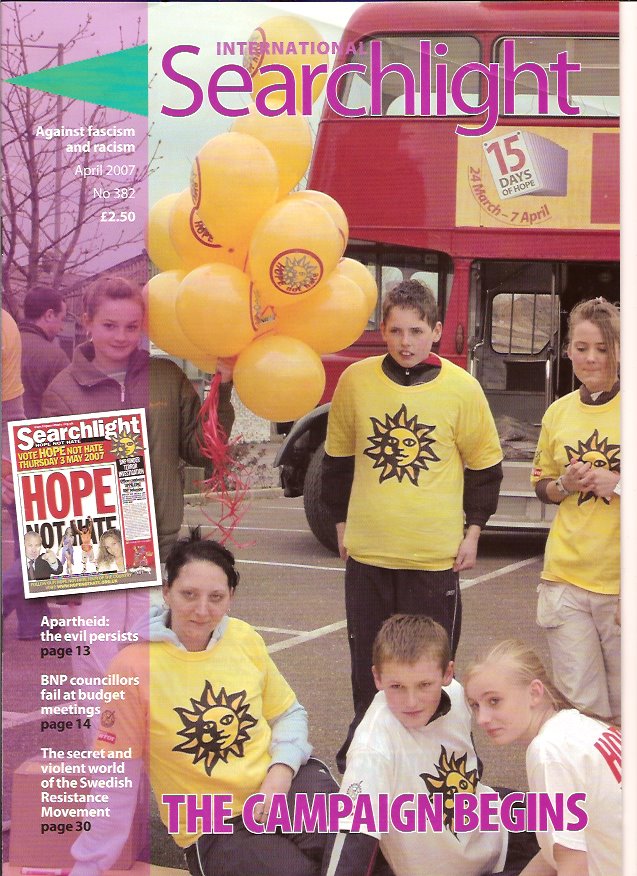
This month’s Searchlight contains the fascinating story that BNP Führer Nick Griffin is facing a leadership challenge from hardline Nazi Chris Jackson, formerly the party’s North West regional organiser (pictured)
The local elections in May were pretty disastrous for the BNP. Despite standing many more candidates their share of the vote fell, in many places dramatically. In the East Midland in 2006 their candidates got 28% of the vote, one year later this fell to 18.5%; in the North West the vote fell from 20.6% to 14.9%. In every region the vote was down. The national average vote fell from 19.2% for 363 candidates last year to 14.7% this year, for 742 candidates.
The won 9 seats, but lost eight they were defending, and one BNP councillor in Stoke has left the party since the election.
Had they been predicting just holding on, they might have been philosophical, but they were confident of doubling their number of elected councillors from 49 to 100.
Of course the BNP vote is still troublingly large, but they are cherry picking favourable seats, and their ability to get a reasonable protest vote at local council level does not translate into sustained and stable electoral support.
Jackson’s leadership challenge would probably not have happened if Griffin’s strategy was paying off. As I wrote last year : “Knowing that the BNP is decades away from forming a government, Griffin is hoping to play the long game. It must seem very galling that a post-fascist like Gianfranco Fini can be deputy Prime Minister in Italy, while Cambridge educated Griffin is talking to 20 numbskulls in a pub skittle-alley in Keighley. In the medium term if the BNP could win a swathe of councillors across the country, it might be able to shift the political agenda so that race and immigration are part of mainstream debate. If it could distance itself from its fascist past it might be able to join coalition administrations in councils, it might get MEPs, and members of the London Assembly elected. With this higher profile it might become a permanent part of the political landscape, a much better foundation for launching a future openly fascist party.”
But why should hardline nationalists put up with Griffin’s attempt to water down their message of race hate in order to position the BNP as a post-fascist party like Fini’s Alleanza Nazionale, if it isn’t even working?
Again, as I wrote last year: “Any sustained organisation requires a cadre of activists that are motivated by an ideology. The current leadership and cadre of the BNP come from fascist backgrounds, and have the criminal records to prove it. This creates a complex difficulty for Griffin. To turn out the existing cadre to work in elections requires sufficient concessions to them that the BNP is not just a racist, but an active race-hate organisation, which is an obstacle to gaining greater respectability. What is more, the party is unable to have a truly candid debate about the need for a shift without revealing the Nazi ideology of many of its supporters, and even exposing them to prosecutions for incitement to racial hatred. The fascist core of BNP supporters are correct to fear the possibility that the BNP could become what it is pretending to be. If Griffin could get elected to the European parliament he would be mainly interested in sustaining his own electoral career.”
So Jackson’s leadership bid is significant. He is standing on behalf of the Reform Group, a small network of Tyndall supporters, and he is seeking to reach out to those fascists that have been excluded by the Griffin regime and are now huddled in the National Front, England First, and other miniscule groups.
As such, his base within the BNP is very limited, but he may tap into a wider discontent with the arbitrary and capricious way Griffin runs the party. Searchlight speculates that the BNP's cultural officer, Jonathan Bowden and elections officer, Eddy Butler, may back Jackson. Anything less than a convincing victory for Griffin, with 80% or more of the membership vote, would seriously damage his authority.
Certainly Griffin’s strategic choice to steer the party towards the political mainstream is problematic. As I argued before: “It is important to understand that the BNP are an openly racist not an openly fascist organisation. The interplay between its fascist and populist elements is a source of weakness for it.”
If Griffin fares poorly in the leadership election this will strengthen the open fascists in the party, weakening the electoral strategy, and increasing the party’s image problem. On the other hand, if Griffin wins a convincing victory, then the fascist cadre of the party may walk out, strengthening the mood that the party has lost momentum, and reducing the number of committed activists prepared to do the donkey work.











.jpg)
.jpg)