Showing posts with label spain. Show all posts

Tuesday, May 01, 2007

Voices from Spain


My grandmother died in 1936, one week after giving birth to her fourth child, she had lost a son who had died as an infant a year earlier. She was twenty seven years old. Poverty and malnourishment were certainly factors in these tragedies. My granddad had been out of work for four years. He was a fitter in the steelworks in Scunthorpe, and had been sacked for refusing to shake the hand of an aristocrat being shown round the works.

It was an act of immature ultra-leftism, but the left had been driven a bit crazy after the defeat in the general strike in 1926. My granddad used to tell me how the strike in Scunthorpe had been completely solid, but when they were sent back to work by the TUC and their own union’s leaderships (The AEU in his case) the bosses were standing at the gates, and known militants and CP members were not let back into the plant. They were tapped on the shoulder, and told: “Not you, lad”.

Unemployment in the 1930s meant appalling poverty, and means test inspectors. The family subsisted largely on vegetables grown on my granddad’s allotment. (My mother has recently been widowed, and was means tested for her pension credit, which she found deeply shocking – it shows how few roots New Labour have in the history and traditions of our movement that they don’t understand the disgust her generation have for means testing). My grandparents stayed politically active, and my mum tells me that one of her earliest memories was the family sitting round the table making a detailed budget of their meagre pennies so that they could send as much money as possible to the Weekly Worker’s (now the Morning Star) fighting fund.

For class conscious workers the nineteen thirties brought tragedy after tragedy. In 1931 the Labour Party imploded, with prime minister Ramsey Macdonald and chancellor Phillip Snowden leading the parliamentary party into a national government with the Tories to cut unemployment benefit. In the ensuing election the unions effectively refounded the Labour Party by backing those candidates who refused to support the national government, but these real Labour candidates were decimated at the polls.

In 1933 the biggest and most organised working class movement in the world was utterly defeated by the Nazis coming to power in Germany. In 1934 fascists came to power in Austria, but there was a chink of light as workers in Vienna rose up and fought. Of course the full horror of Nazi rule was still in the future, but everyone still knew that these were parties that would crush dissent with an iron heel, and were prepared to return to the full scale carnage of war, still a recent memory.

So in 1936, when there was an attempted fascist coup in Spain, my granddad decided enough was enough and he would go to Spain to fight. The rise of fascism would have to be halted. He was not a well educated man, or a party cadre who followed the twists and turns of Palme Dutt's theories, but he knew in his heart that fascism had to be stopped, and that it would not be stopped by the “democracies” of Britain and France, it would only be stopped by working men and women like him taking up arms.

From the hindsight of the twenty first century it seems bizarre that he would consider leaving his pregnant wife and two children, but he had made arrangements that they would be supported by his family. Attitudes were different, and he was a man of his time.

But then, a few weeks before his intended departure, his wife died. Not only was he distraught with grief, but he had a new baby to look after: so he never went to Spain.

It is not a very remarkable story perhaps. But it is a story that illustrates the type of men who gave up everything and went to Spain, principled working men. The International brigaders were typically not George Orwells or Ernest Hemingways, they were trade unionists, engineers, clerks, shop workers, posties and railwaymen.

A lot of divisive commentary is written about the Spanish civil war on the left. The divisions and debates on the left at the time about how the war should have been fought belong to an earlier age, and we will never swim in that river again. Despite the self-assurance of those who follow Trotsky’s writings on Spain, we don’t know that there would have been a victory had his advice been followed (and certainly virtually no one was listening to him in Spain at the time). But we can be pretty sure that without Russian tanks and aircraft, and the heroism of the Russian volunteers who flew them, that Madrid would have fallen to the fascists in November 1936 and the war would have been over.

The important thing is to commemorate and celebrate the whole memory of those who fought, those who died and those who survived, which ever tradition they came from. These are the heroes of our class, who put their lives on the line to stop fascism.

It is therefore really valuable to listen to their own voices, which we can do through the book “poems of Spain” published by Lawrence and Wishart, and available from Philosophy Football for £10.99

What happened to my granddad? Well, rearmament meant he got his job back, and during the second world war he worked 12 hour shifts, six days per week helping to keep the steel mills working. The steel used to build the tanks, planes and bombs that won the war against fascism. He was a lifelong communist, and a member of the Labour Party (which seems a bizarre anachronism these days, but was not at all unusual in the past, which just underlines the transformation that Kinnock and Blair have achieved)

Monday, February 12, 2007

Commemorate those who fought fascism.

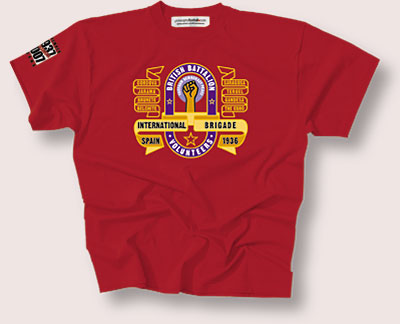
Philosophy Football have just produced this excellent T-shirt to commemorate the comrades of the British battalion of the International brigade.

Seventy years ago this week the British battalion fought in their first battle at Jarama. Volunteers from the British Isles totalled 2,300, of whom 525 died in Spain.

The 16th British Battalion was formed in December 1936 from new arrivals plus veterans of the battle for Madrid. It comprised volunteers from Britain, Ireland and from various Commonwealth countries and beyond.


The battalion was formally integrated into the Spanish Republican Army in January 1937 as part of the 15th International Brigade, itself part of the 35th Division. Initially it was named the Saklatvala battalion, after the Indian Communist MP for Battersea, but the name never caught on and it was known in Spain as ‘el batallón ingles’. From November 1937, following a reorganisation of the Republican Army the British Battalion became the 57th Battalion. It was withdrawn in October 1938.

The anniversary T-shirt features a superb reproduction of the British Battalion's original banner, the slogan reads 'Freedom, Democracy, Peace' with battle honours listed including Jarama, Brunete and Ebro.

Wednesday, January 24, 2007

No Pasaran - remember our war heroes


Philosophy Football have organised a celebration to mark the seventieth anniversary of the Battle of Jarama, the first major engagement of the British section of the International Brigades in the Spanish Civil War.

FRIDAY 16 FEBRUARY 'No Pasaran: A Night of Protest Song, Verse and Film'

The night begins with a specially commissioned film mixing rarely seen archive film footage with interviews of surviving international brigaders. The film has been put together by Simon Green of www.eventful.org.uk

Attending the event will be Jack Jones, political commisar of the British Battalion's Number One 'Major Attlee' Company and Sam Lesser who was one of the first British volunteers to join the International Brigade, serving in the October 1936 defence of Madrid, and involved in propaganda work in Barcelona after being wounded at Lopera in 1937.The brigaders will be introduced by Jim Jump, trustee of the International Brigade Memorial Trust.

Poets Mike Rosen, Andy Croft and Lemn Sissay will be reading both from their own work and the poetry of International Brigders compiled in the superb collection recently published by Lawrence & Wishart, 'Poems from Spain'.

And closing this most special night folk legend Leon Rosselson, with Robb Johnson and Tracey Curtis play a set of protest songs old, and new. With soundsystem provided by our in-house DJ MelstarsUK: Music

With a late licence and food available another great Friday night out! Presented by Philosophy Football in association with the International Brigade Memorial Trust and supprted by the GMB's 'BNP-Free Zone' campaign. Starts 7pm at Offside Bar, 271 City Road, London EC1.

Its FREE, continuing Philosphy Football’s commitment to renewing a political culture of dissenting ideas and dangerous entertainment that refuse to be commodified!

BUT advance registration is ESSENTIAL. REGISTER by emailing them at events@philosophyfootball.com with name(s).

Do PLEASE spread the word but advise friends and contacts to register early!

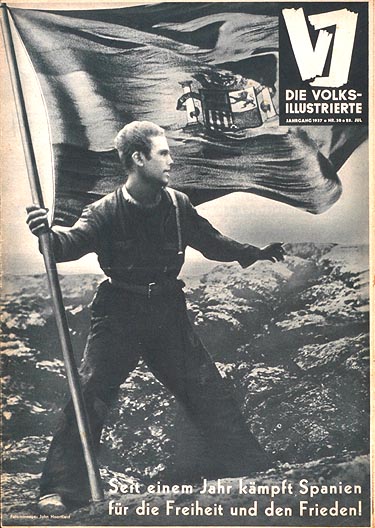
The poster shown is by John Heartfield (a lesser known example of his photomontages) produced in 1937 to mark the first anniversery of the start of the war, for the German socialist publication, Die Volks-Illustrierte (the caption reads "for one year Spain has fought for Peace and Freedom")

Please also note the interesting post by Charlie Pottins of the forthcoming 100th birthday of International Brigader Howard Andrews from Taunton

Monday, September 25, 2006

Brilliant Socialist Theatre


Two years ago, Steve Trafford authored the really great play about Maykovsky, “A Cloud in Trousers”. I wrote a review of it at the time, and interveiwed Trafford. The interview is very interesting and worth reading.

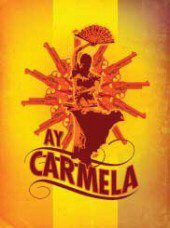
It is therefore excellent news that Trafford has translated and adapted the classic Spanish play, “¡Ay Carmela!” by Josè Sanchis Sinisterra into English. It is currently playing in York, and the
reviews are good. Writing in the British Theatre Guide, Julie Atkinson says, “Sinisterra's two-hander … presented translator Steve Trafford with a challenge: how to do justice to the author's poetic yet colloquial style. Despite not being a fluent Spanish speaker (he freely admits to using a literal translation, a French translation and Spanish and French dictionaries), Trafford succeeds brilliantly. The ear quickly becomes attuned to picking up his clever but unobtrusive use of alliteration and internal rhymes, yet the dialogue never sounds contrived or self-consciously "poetic" - quite an achievement in a work so strongly influenced by the work of Samuel Beckett and the Latin American tradition of magic realism.
“Elizabeth Mansfield, who co-founded Ensemble with Steve Trafford, is ideally cast as Carmela. As well as giving a wonderfully funny and moving performance she also has a thrilling singing voice which is used to the full in several musical numbers. Robert Pickavance gives a tour de force performance as the harassed Paulino, in comparison with whom Basil Fawlty is positively laid-back. The couple perform their flamenco routine with real panache and their interaction, both "on-stage" and behind the scenes, has the easy familiarity born of long experience. It's easy to believe that these two have been working together for years.”


“¡Ay Carmela!” was filmed in 1991 starring Carmen Maura, and concerns the fate of a Republican theatre troupe who stray behind fascist lines during the Spanish Civil War. They are arrested, and fear a firing squad, but they receive a reprieve from an Italian Fascist commander who loves the theatre. He arranges a performance for his troops, bargaining with the actors that they stage a burlesque mocking the republic in exchange for their freedom.

This theme of the relationship of the individual artist to facsism is of course reminiscent of
István Szabó’s brilliant 1981 film, “Mephisto”, but the wider issues of artistic responsibility are also familiar territory for Trafford himself. He was a founder in the 1970’s of the Red Ladder theatre company but now earns his living writing for television. As he says: “We are in a … set of contradictions. Mayakovsky says "All art serves, either as we dream the world can be; or as the world is, contributing to more dust settling on our hopes." You are caught in that trap aren't you? What are you contributing? Attempting through your art to shift and shunt the way in which the world is moving? And artists today I think feel incredibly marginalised by commercial art.”

“A Cloud in Trousers” explored the difficult position of the explosive genius Mayakovsky and his responsibility to continue artistic rebellion even as the walls were closing in on him through Bolshevik conformity. ““¡Ay Carmela!” concerns itself with the closely related dilemma of whether artists should stay true to their beliefs or should bow to pressure and allow their talents to be used to serve reactionary goals.

These are serious questions, Trafford is a brilliant playwright, and the Ensemble company, including the extremely talented Elizabeth Mansfield, are performers of rare ability. It is a joy to see such first class socialist theatre being performed. Make sure you go and support this play.

“¡Ay Carmela!” is showing in York till 30th September, then Darlington, Bolton, Leicester, Farnham, Tunbridge Wells, Frome, Chipping Norton, Beetham, Shepperton, Taunton, Halesworth, London Shaw Theatre (7 to 18 November), Cardiff and Cheltenham.


Worth adding for those in London; The tour will include a gala evening on November 7th, at the start of the London run at the Shaw Theatre, in association with the International Brigade Memorial Trust, celebrating the heroism of men and women from all over the world who volunteered their lives in the fight against fascism.

Friday, September 22, 2006

Make Your Front Popular


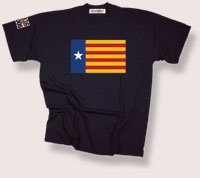
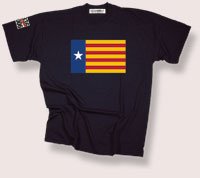
Those nice people at Philosophy Football have produced a series of T-shirts to commemorate the Spanish Civil War.

As Mark Perryman says: “We've tried to break with all the sectarian nonsense around this period, whatever our views of the communists or anarchists these were men and women who gave their lives in the fight against fascism so the entire memory should be respected. We're hoping to raise some dosh for the International Brigade Memorial Trust.”

I think Mark is completely correct here. I recently watched that Ken Loach film “Land and Freedom” again and I was a bit weary of the caricature of the CP international brigaders. Not only was it bad history to only show one side of the story, it also reduced the dramatic power. For example the CP are only shown fighting other lefties, there was no hint, for example, of the immense role played by the Russian air force in preventing the fall of Madrid, and the fact that there was real substance to the CP’s argument that only a professionalised army could beat the fascists. In a bizarre twist of history the argument used by Trotsky for a professional army in the Russian Civil War was put forward by the official CP in Spain, while the semi Trotskyists of POUM echoed the position of Stalin’s supporters in the Russian Red Army, that there should be a proletarian militia.

In any event – the civil war was 70 years ago, and much of the historical baggage has simply got to be put to bed.

Philosophy Football have produced these shirts, because in Mark’s own words: “Seventy years ago in 1936 the Spanish Republic were joined by the International Brigade, thousands anti-fascist volunteers from around the world, in the battle for land and freedom. Their foe, Franco and his Fascists were backed by Hitler and Mussolini while the British and other governments shamefully hid behind so-called 'Non aggression' to starve the Republicans of supplies and munitions. The battle cry of the Republic was No Pasaran , 'They shall not pass', the heroism, solidarity and sacrifice in the face of Franco's overwhelming force has inspired anti-fascists ever since.”

The four shirts depict different forces united in Spain's battle. The flag of the Left Party of Catalonia, the Catalonians like the Galicians and Basques recognised the need to unite behind the Republic against Franco. The banner of the Tom Mann Centuria, formed by British volunteers in Barcelona this unit went on to become the basis of the British Battalion of the International Brigade. Tom Mann was a militant trade unionist and founder of the Communist Party of Great Britain. The banner of the POUM militia, the unit with which George Orwell famously served. And the banner of the anarcho-syndicalist CNT-FAI, critics of the Popular Front government but allies in the fight against fascism.

Apparently sales have been going very well, and people have been buying combinations of shirts in an encouragingly non-sectarian way. Although I am pleased to report that the Tom Mann shirt is the most popular!


Friday, April 28, 2006

Basque leader and peacemaker jailed for praising ETA leader

Anyone following debates about the criminalisation of political expression in the name of defending against terrorism should note this story in The Independent.

Basque leader is jailed for praising former head of Eta
Elizabeth Nash in Madrid
28 April 2006
Arnaldo Otegi, the radical Basque politician and a key figure in the incipient peace process, has been jailed for 15 months for glorifying terrorism.

Spain's High Court also banned Otegi, one of the most prominent and outspoken leaders of Basque nationalism, from standing for political office or voting for seven years at yesterday's hearing. Otegi, 47, the leader of the outlawed pro-separatist Batasuna party, is thought to have played a decisive role in persuading Eta armed separatists to declare a permanent ceasefire last month.

He had long been in discreet contact with members of the ruling Socialist party to prepare for the ceasefire, and is considered Spain's nearest equivalent to Sinn Fein's leader, Gerry Adams, in his importance to the Basque peace process.

While Basque Socialists consider him a key interlocutor, Otegi is one of the few non-combatant radical Basques with clout among Eta's military hotheads - because of his record as a former Eta hitman. He is likely to be a vital participant in future peace talks.

"I think the bases for the abandonment of violence are firm and will not be affected by these kind of events," the Socialist parliamentary spokesman, Ramon Jauregui, said.

Otegi was sentenced for praising the Eta leader Jose Miguel Benaran Ordenana, known as Argala, at a memorial service in 2003. He denied at his trial this month his homage amounted to the glorification of terrorism or Eta. "My message was only an act of remembrance for a person murdered 25 years ago for political reasons," he had said.

Argala was suspected of masterminding the assassination in 1973 of Franco's right-hand man, Admiral Luis Carrero Blanco, whose death in an explosion shook the dictatorship's foundations. Argala was amnestied in 1977 and murdered a year later, supposedly by extremists seeking vengeance for Blanco's death.

Otegi is on bail in connection with a trial to establish Batasuna's links with Eta. He was sentenced to a year in jail in November for insulting the king, whom he accused of being "responsible for torturers", but the term was waived as "a first offence". He can appeal to the Supreme Court, which has the last word on whether he should go to jail for the latest offence.

Before the court ruling yesterday, Otegi sought permission to travel to Dublin to take part in Sinn Fein events, invited by Gerry Adams. Mr Adams is said to have advised him on how to orchestrate Eta's transition from armed action to peace talks, and has praised him publicly.
---
For the record: I'm still celebrating the assassination of Carrero Blanco as an important blkow against a fascist regime.