All the rabid frothing from Blair and his court jesters about Iran’s capture of British sailors and marines is - to use that now trite word - hypocritical. Those who have crowed the most are those who have no doubt climaxed at the sight of kidnapped orange jump-suited men and children and now dream of cruise missiles raining down on Tehran.
Had the Iranian regime followed the example of the "War On Terror" shackled the sailors and marines in chain-gang style, tortured them (while euphemistically calling it something else), refusing access to legal counsel, denied them the status of combatants and all the legal restrictions that go with it, flown them around in chartered planes and introduced to seasoned torturers, cruise missiles would be raining down on Tehran. Perhaps there is a woman in a U.S. "ghost prison" called "Fayetima Turneyma".
Had the Iranian regime followed the example on the "War On Terror" and said that commenting on the captives would be to capitulate to terrorism (no more ridiculous than the children held in Guantanamo said to be terrorists), the cruise missiles would be raining down on Tehran. It’s lucky, then, that the Iranian regime says no such thing and, instead, states that it is conducting its investigations and will come to a decision.
When Guantanamo detainees are pictured, tortured and forced to confess, that is part of the "War on Terror". When British sailors and marines are pictured tucking in to some food (let alone "waterboarded"), that is an outrage. As it is, unbelievably, amazingly, unimaginably, the Ayatollahs are operating at a much higher moral plane regarding detainees than the democratically elected and liberal Blair government.
Hypocrisy is said to be refusing to apply the same standards to yourself that you apply to others. The passionate Blair has surpassed the standard of hypocrisy quite admirably. Few have noticed that he refuses to apply the same standard to his conduct that he demands of others.
Showing posts with label Imperialism. Show all posts
Showing posts with label Imperialism. Show all posts
Thursday, March 29, 2007


Sunday, March 25, 2007
Canada's Ex-Ambassador To Yugoslavia Speaks Out
Interesting words from James Bissett, Canada's Ambassador to Yugoslavia 1990-1992:
'This weekend marks the eighth anniversary of the U.S.-led NATO bombing of Yugoslavia. The implications of that action are still with us.
'The onslaught that began March 24, 1999, continued for 78 days, causing an estimated 10,000 civilian casualties and inflicting widespread damage on the country's infrastructure. The North Atlantic Treaty Organization's unprecedented attack against a sovereign state was done without United Nations authority and in violation of the UN Charter and international law. It also set a dangerous precedent: It transformed NATO from a purely defensive organization into a powerful alliance prepared to intervene militarily wherever it chose to do so. And it paved the way for the unilateral U.S. invasion of Iraq.
'Bill Clinton and other NATO leaders justified the bombing on humanitarian grounds. It was alleged that genocide was taking place in Kosovo and that Serbian security forces were driving out the Albanian population. Later, it was disclosed there was no genocide in Kosovo. (Of course, the outcome appears to be an independent quasi-state of Kosovo, as shall be recommended next week to the UN Security Council.) Before the bombing, several thousand Albanians had been displaced within Kosovo as a result of the fighting between Serbian security forces and the Kosovo Liberation Army. But nearly all of the Albanians who fled Kosovo did so after the bombing began. The real ethnic cleansing came after Serbian forces withdrew and more than 200,000 Serbs, Roma, Jews and other non-Albanians were forced to flee; more than 150 Christian churches and monasteries have since been burned by Albanian mobs.
'The bombing had little, if anything, to do with humanitarian concerns. It had everything to do with the determination of the United States to maintain NATO as an essential military organization. The fall of the Berlin Wall, the collapse of the Soviet Union and the withdrawal of Warsaw Pact armies had called into question NATO's reason for existence. Why was such a powerful and expensive military organization needed to defend Western Europe when there was no longer any threat from Soviet communism?
'The armed rebellion by the terrorist Kosovo Liberation Army provided Washington with the opportunity needed to demonstrate to Western Europe that NATO was still needed. So, it was essential to convince the news media and the public that atrocities and ethnic cleansing were taking place in Kosovo.This was done with relative ease by a campaign of misinformation aimed at demonizing the Serbs and by assertions by Mr. Clinton, Tony Blair and other NATO spokesmen that hundreds of young Albanian men were "missing" and that mass executions and genocide were taking place in Kosovo. Compliant journalists and a credulous public accepted these lies.
'In April, 1999, at the peak of the bombing, Mr. Clinton gathered NATO's political leaders in Washington to celebrate the alliance's 50th birthday. The party was used as a platform for Mr. Clinton to announce a new"strategic concept" -- NATO was to be modernized and made ready for the new century. There was no reference to defence or the settling of international disputes by peaceful means or of complying with the principles of the UN Charter. The new emphasis would be on "conflict prevention," "crisis management" and "crisis response operation."
'Usually when a treaty is to be amended or changed, it must be approved and ratified by the legislatures of the contracting states. This was not done with the North Atlantic Treaty. It was changed by an announcement from the U.S. president, with little or no debate by the legislatures of member countries. It may well be that NATO should be in a position to intervene militarily in the internal affairs of another country, but it surely is essential that the ground rules for such intervention be in accordance withthe UN Charter and only after concurrence of member states. NATO should not become a convenient political "cover" to justify the use of military power by the United States.'
'This weekend marks the eighth anniversary of the U.S.-led NATO bombing of Yugoslavia. The implications of that action are still with us.
'The onslaught that began March 24, 1999, continued for 78 days, causing an estimated 10,000 civilian casualties and inflicting widespread damage on the country's infrastructure. The North Atlantic Treaty Organization's unprecedented attack against a sovereign state was done without United Nations authority and in violation of the UN Charter and international law. It also set a dangerous precedent: It transformed NATO from a purely defensive organization into a powerful alliance prepared to intervene militarily wherever it chose to do so. And it paved the way for the unilateral U.S. invasion of Iraq.
'Bill Clinton and other NATO leaders justified the bombing on humanitarian grounds. It was alleged that genocide was taking place in Kosovo and that Serbian security forces were driving out the Albanian population. Later, it was disclosed there was no genocide in Kosovo. (Of course, the outcome appears to be an independent quasi-state of Kosovo, as shall be recommended next week to the UN Security Council.) Before the bombing, several thousand Albanians had been displaced within Kosovo as a result of the fighting between Serbian security forces and the Kosovo Liberation Army. But nearly all of the Albanians who fled Kosovo did so after the bombing began. The real ethnic cleansing came after Serbian forces withdrew and more than 200,000 Serbs, Roma, Jews and other non-Albanians were forced to flee; more than 150 Christian churches and monasteries have since been burned by Albanian mobs.
'The bombing had little, if anything, to do with humanitarian concerns. It had everything to do with the determination of the United States to maintain NATO as an essential military organization. The fall of the Berlin Wall, the collapse of the Soviet Union and the withdrawal of Warsaw Pact armies had called into question NATO's reason for existence. Why was such a powerful and expensive military organization needed to defend Western Europe when there was no longer any threat from Soviet communism?
'The armed rebellion by the terrorist Kosovo Liberation Army provided Washington with the opportunity needed to demonstrate to Western Europe that NATO was still needed. So, it was essential to convince the news media and the public that atrocities and ethnic cleansing were taking place in Kosovo.This was done with relative ease by a campaign of misinformation aimed at demonizing the Serbs and by assertions by Mr. Clinton, Tony Blair and other NATO spokesmen that hundreds of young Albanian men were "missing" and that mass executions and genocide were taking place in Kosovo. Compliant journalists and a credulous public accepted these lies.
'In April, 1999, at the peak of the bombing, Mr. Clinton gathered NATO's political leaders in Washington to celebrate the alliance's 50th birthday. The party was used as a platform for Mr. Clinton to announce a new"strategic concept" -- NATO was to be modernized and made ready for the new century. There was no reference to defence or the settling of international disputes by peaceful means or of complying with the principles of the UN Charter. The new emphasis would be on "conflict prevention," "crisis management" and "crisis response operation."
'Usually when a treaty is to be amended or changed, it must be approved and ratified by the legislatures of the contracting states. This was not done with the North Atlantic Treaty. It was changed by an announcement from the U.S. president, with little or no debate by the legislatures of member countries. It may well be that NATO should be in a position to intervene militarily in the internal affairs of another country, but it surely is essential that the ground rules for such intervention be in accordance withthe UN Charter and only after concurrence of member states. NATO should not become a convenient political "cover" to justify the use of military power by the United States.'
If Brzezinski Is Worried...

Zbigniew Brzezinski is probably America’s most important imperial thinker. Not as deranged as the neocons and not as shortsighted as Henry Kissinger (but that ain’t saying much, especially given Brzezinski’s crucial role in masterminding the jihad against the Soviet Union), Brzezinski is the man to run an empire. In some sense, one should be thankful he was not at the helm post-9/11: the empire would have expanded and strengthened. As it is, the empire has been weakened, but the destruction wrought in the process is nightmarish.
Essentially, the U.S. foreign policy elite are a combination Brzezinskists and Kissingerians, with the recently arrived (and despised) neocons, a lunatic strain of imperial thought who pretend not to adore Kissinger, now very much in the background, having virtually wrecked the U.S. empire. Another two terms of neocon foreign policy and the empire will be lost. Hence the outrage within foreign policy circles in the United States.
What Brzezinski says is important - not because of who he was but of what he represents. And if he’s worried, well, we all better be worried:
“If the United States continues to be bogged down in a protracted bloody involvement in Iraq, the final destination on this downhill track is likely to be a head-on conflict with Iran and with much of the world of Islam at large. A plausible scenario for a military collision with Iran involves Iraqi failure to meet the benchmarks; followed by accusations of Iranian responsibility for the failure; then by some provocation in Iraq or a terrorist act in the U.S. blamed on Iran; culminating in a ‘defensive’ U.S. military action against Iran that plunges a lonely America into a spreading and deepening quagmire eventually ranging across Iraq, Iran, Afghanistan, and Pakistan.”
Saturday, March 24, 2007
Great Iraqi oil rip-off - continued
I attended the Socialist Resistance conference on the Middle East today. Instead of giving a detailed take on the day I want to concentrate on the talk given by Ewa Jasiewicz, who I have heard speak before at Labour Against the War (LAtW) and Iraq Occupation Focus events. Anyway, if you want to get a full flavour of the day I am sure Cecil B. Mac Uaid will be putting up the edited highlights of day on his blog.
Ewa represented the organisations Platform and Hands Off Iraqi Oil. She spoke about the impending Hydrocarbon Law that was put together by Iraqi technocrats overseen by the Bush administration and the IMF. It is expected to become law in May. If not, the Bush and the oil companies administration will be very very unhappy!
This law is utterly pernicious as it favours production sharing agreements that can last up to 25-40 years or indefinitely. There are "stabilisation clauses" that mean that the government won't be able to change tax rates or pass any new laws that affects the oil company profits. It is in reality, control of the oil from the Iraqis to the oil companies. This will in effect overide Iraqi sovereignity. This new law will be de facto privatisation. Iraq has the 3rd largest oil reserves and 12th for oil production. It is a lucrative business with western Oil companies grabbing up to 75% of the profits.
The Federation of Oil Unions in Iraq are bravely fighting this law. In a joint statement with other Iraqi trade unionists:
"The handing of control over oil to foreign companies, whose aims is to make big profits at the expense of the Iraqi people, and to rob the national wealth, according to long-term, unfair contracts, that undermine the sovereignity of the state and the dignity of the Iraqi people"..
There is strike action planned by the oil workers once this law is passed (May/June) and there will be inevitable bloodshed and to be blunt, a killing spree orchestrated by the goon squads employed by the oil companies. Ewa stressed the importance to show solidarity with the oil workers. The union has grown from 23,000 to 26,000 within the past couple of months.
Other initiatives to protest against this vile law is demonstrating outside BP AGM, flood emails to Blair and Beckett and there is an EDM tabled by MP Katy Clark that has received support of 24 MPs (including 1 Tory!). The need to raise awareness is imperative as Iraqi oil will go the same way as Colombia and Nigeria where violent repression including murder is used to crush opposition including trade unionists.
To the pro-war left, isn't it time you protested against the plundering of Iraqi oil as it goes against your principle of bringing "freedom" to the Iraqi people?
Ewa represented the organisations Platform and Hands Off Iraqi Oil. She spoke about the impending Hydrocarbon Law that was put together by Iraqi technocrats overseen by the Bush administration and the IMF. It is expected to become law in May. If not, the Bush and the oil companies administration will be very very unhappy!
This law is utterly pernicious as it favours production sharing agreements that can last up to 25-40 years or indefinitely. There are "stabilisation clauses" that mean that the government won't be able to change tax rates or pass any new laws that affects the oil company profits. It is in reality, control of the oil from the Iraqis to the oil companies. This will in effect overide Iraqi sovereignity. This new law will be de facto privatisation. Iraq has the 3rd largest oil reserves and 12th for oil production. It is a lucrative business with western Oil companies grabbing up to 75% of the profits.
The Federation of Oil Unions in Iraq are bravely fighting this law. In a joint statement with other Iraqi trade unionists:
"The handing of control over oil to foreign companies, whose aims is to make big profits at the expense of the Iraqi people, and to rob the national wealth, according to long-term, unfair contracts, that undermine the sovereignity of the state and the dignity of the Iraqi people"..
There is strike action planned by the oil workers once this law is passed (May/June) and there will be inevitable bloodshed and to be blunt, a killing spree orchestrated by the goon squads employed by the oil companies. Ewa stressed the importance to show solidarity with the oil workers. The union has grown from 23,000 to 26,000 within the past couple of months.
Other initiatives to protest against this vile law is demonstrating outside BP AGM, flood emails to Blair and Beckett and there is an EDM tabled by MP Katy Clark that has received support of 24 MPs (including 1 Tory!). The need to raise awareness is imperative as Iraqi oil will go the same way as Colombia and Nigeria where violent repression including murder is used to crush opposition including trade unionists.
To the pro-war left, isn't it time you protested against the plundering of Iraqi oil as it goes against your principle of bringing "freedom" to the Iraqi people?
Tuesday, February 27, 2007
Milosevic - "officially" Not Guilty!

Yesterday’s ruling of the UN International Court of Justice in The Hague that the Serbian state was not directly responsible for any genocide in Bosnia has a very clear implication.
Had President Slobodan Milosevic not died in custody he would have been acquitted, and found not guilty of the charges brought against him.
As Harold Pinter, Nobel Prize laureate for Literature 2005 said: “The US/NATO court trying Slobodan Milosevic was always totally illegitimate. It could never be taken seriously as a court of justice. Milosevic's defense is powerful, convincing, persuasive and impossible to dismiss.”
The probability of Milosevic’s acquitall had already been noted, even by some who supported the show trial, despite the fact that in the highly politicised context of this trial the presumption of innocence had already been discarded. In July 2004, James Gow, an “expert” on war crimes, and a cheer-leader for the prosecution told BBC Newsnight that he thought it would be better if Milosevic died in the dock, because if the trial ran its course he might be sentenced for only relatively minor charges.
As reported in the Spectator: “Since the trial started in February 2002, the prosecution has wheeled out more than 100 witnesses, and it has produced 600,000 pages of evidence. Not a single person has testified that Milosevic ordered war crimes. Whole swaths of the indictment on Kosovo have been left unsubstantiated, even though Milosevic’s command responsibility here is clearest. And when the prosecution did try to substantiate its charges, the result was often farce. Highlights include the Serbian ‘insider’ who claimed to have worked in the presidential administration but who did not know what floor Milosevic’s office was on; ‘Arkan’s secretary’, who turned out to have worked only as a temp for a few months in the same building as the notorious paramilitary; the testimony of the former federal prime minister, Ante Markovic, dramatically rumbled by Milosevic, who produced Markovic’s own diary for the days when he claimed to h ave had meetings with him; the Kosovo Albanian peasant who said he had never heard of the KLA even though there is a monument to that terrorist organisation in his own village; and the former head of the Yugoslav secret services, Radomir Markovic, who not only claimed that he had been tortured by the new democratic government in Belgrade to testify against his former boss, but who also agreed, under cross-examination by Milosevic, that no orders had been given to expel the Kosovo Albanians and that, on the contrary, Milosevic had instructed the police and army to protect civilians. And these, note, were the prosecution witnesses.”
It has been very hard to follow the story of Milosevic’s trial in the British press. Is that because the narrative provided by the evidence did not support the cosy but mendacious case that the Serbian state were responsible for war crimes, while NATO’s allies were as pure as the driven snow. The myth of the innocent Bosnian Muslims was dealt a blow when Eve-Ann Prentice, a journalist who has written for the Guardian and the Times, testified in court that in November 1994, while she was waiting in Izetbegovic's foyer both she, and a journalist from Der Speigel, saw Osama bin Laden being escorted into Izetbegovic's office.
The popular perception of Serbia being the villain in Yugoslavia remains unshaken. Yet it has recently been established that the first war crime in modern Yugoslavia was the illegal execution of three prisoners of war (two Serbs and a Croat) in Slovenia in 1991, yet the Slovenian government declines to prosecute, and is feted as a model democracy by the EU.
It should be noted that the Serbian state has been found guilty of failing to prevent genocide at Srebrinica in 1995, where perhaps 7000 Muslims were murdered by Bisnian Serb militias. These are serious charges, but note that Milosevic is widely credited with having had the dangerous Serb fascist Arkan assassinated due to his role in Ethnic cleansing (he was too powerful to have dealt with by lawful process), and General Farkas, chief of the Security Dept. of the Yugoslav Army in 1999, gave testimony in The Hague that when Milosevic learned of crimes committed by reserve policemen who had associated with Slobodan Medic "Boca," he became extremely angry. He demanded an explanation of how the Skorpions commander could have been active in Kosovo, then he demanded that the perpetrators be prosecuted and that nothing like that be permitted to happen in the future.
The people really guilty of failing to prevent genocide in Srebrenica were the craven cowards of the Dutch UN peacekeeping force. Yet Dutch Colonel Tom Karremans was not in the dock in The Hague. Around 5000 Bosnian Muslims had taken sanctuary in the UN base, protected by 600 Dutch troops, but Colonel Karremans handed them to Bosnian Serb militiamen, indifferent to their almost certain fate, in return for safe conduct for himself and his men. They even left their weapons behind.
Milosevic may have been guilty of many things. But he was not a war criminal. The Jugoslav state was broken up over a period of years because that suited the interests of the western powers. Serbia stood against that disintegration and also sought to defend parts of its planned economy. That is why there has been a propaganda war to paint the Serbs as the villains. (The wider context of this is explained quite well by Richard at Lenin’s Tomb.)
Monday, February 05, 2007
Wiping Israel off the map??

Frequently we hear that Iran is a dangerous threat becasue the president has threatened to wipe Israel off the map.
John Pilger’s article in Saturday’s Morning Star reminded us of what President Ahmadinejad of Iran actually said:
“A close examination of his notorious remark about Israel revels how it has been distorted.
“According to Juan Cole, US professor of modern Middle East and South Asian history at the University of Michigan, and other Farsi language analysts, Ahmadinejad did not call for Israel to be “wiped of the map”. He said “the regime occupying Jerusalem must vanish from the page of time”
“This, says Cole, “does not imply military action or killing anyone at all”. Ahmadinejad compared the demise of the Israeli regime to the dissolution of the Soviet Union”.
Indeed. The USSR, DDR, the Federal Republic of Yugoslavia and even Czechoslovakia have all vanished from the page of time.
Saturday, May 20, 2006
A shot gun divorce

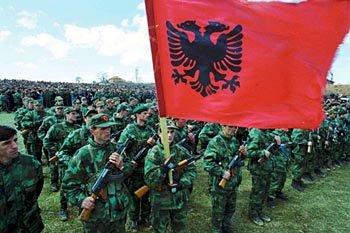
Montenegro will vote this weekend in a referendum whether they wish to stay part of the federation with Serbia. Montenegran prime minister Mr Djukanovic had been a key supporter of Slobodan Milosevic, but increasing international pressure has led to him now supporting independence. Thus the West consecrates their rape of Yugoslavia by a shot gun divorce.
During the 1999 war I was in Budapest for several weeks, a city suddenly awash with Serbian refugees fleeing the NATO bombing. I remember speaking to one Serb woman, herself an activist opponent of Milosevic, who described why her father remained a solid supporter of the Serb government. He had grown up in the mountains during the second world war, when ethnic cleansing and racist murders by Serb and Croatian fascists were an everyday occurrence, He was the seventh son of a peasant, and he was expecting a future of poverty, frustration and ignorance. But Tito ended the ethnic violence, by building unity around the demands ratified by the 1943 Jacje conference in Bosnia where the partisan forces gathered to discuss what a post-war Yugoslavia would look like. The proclamation of an end to ethnic discrimination and redistribution of the land strengthened the military struggle by giving it a firm foundation of support in the countryside. In Tito’s Yugoslavia her father was not a goat herd, but because a university professor.
What a lot of lies we were told. During the build up to the 1999 war, U.S. and British officials at various moments claimed 100,000, 250,000 and 500,000 Serb killings of Kosovo Albanians, along with the lavish use of the word "genocide. But only 4,000 bodies have been found in one of the most intense forensic searches in history, and that includes the bodies of Serbs killed by Albanians, and the victims of 78 days of intense NATO bombing. And much of the killing of Albanians in Kosovo started after the NATO bombing commenced. However tragic and apalling the killings were, the NATO involvement did nothing to halt them, and instead exacerbated the racial tension.
We heard so much of the Serb atrocities, but the media in Britain were almost silent when in March 2004, up to 50000 ethnic Albanian rioters launched a pogrom against their Serb and Roma (Gypsy) neighbours. The pogrom followed delibertely inflammatory and untruthful broadcasts that the tragic drowning of three Albanian boys at the village of Cabra was due to them being driven into a river by a mob of Serbs. An account that the well respected agency Human Rights Watch concluded was completely untrue.
The account of the following pogrom in 2004 by Human Rights Watch is truly shocking. As they report “Once the violence began, it swept throughout Kosovo with almost clinical precision: after two days of rioting, every single Serb, Roma, or Askaeli home had been burned in most of the communities affected by the violence, but neighboring ethnic Albanian homes were left untouched.” NATO troops took 6 hours to respond to calls for help by Serbs in Pristina, despite elderly defenceless and disabled people being attacked in their homes by the mob of Albanian extremists.
It is important to note that according to HRW the ethnic cleansing of minorities by the NATO backed KLA/UCK started immediately after the Serbs withdrew: “Before the 1999 war, some 350 Ashkali families lived in Vucitrn, many of them engaged in the butcher trade. After the war, many of the Ashkali were attacked by ethnic Albanians. At least five Ashkalis from the town were abducted and “disappeared” and more than a hundred Ashkali homes burned. Almost the entire Ashkali community of Vucitrn fled, with only ten to fifteen families deciding to stay.”
In 2004 the Albanian supremacists came to finish the job, watched and not hindered by NATO troops: “the Ashkali recalled the terror they felt when their homes were set on fire with their families inside and no-one came to help them. Nejib Cizmolli, a thirty-seven-year-old Ashkali [man], recalled being trapped on the second floor of his burning home with eleven people, including children aged three, eight, fourteen, fifteen, and sixteen”
If NATO was prepared to go to war with Serbia because of the alleged (and largely untrue) massacres of Albanians in Kosovo by the Serb army, then how could they collude in ethnic cleansing under their very noses, while they are administering the province themselves? In truth the war was always about dismantling Yugoslavia, and never about preventing ethnic cleansing. If the Milosevic government was truely promoting Serb racial supremacism, why did the large Hungarian minority in Vojvodnia stay loyal to Belgrade? Why were the Roma people in Kosovo protected by the Serbs but massacred by the KLA?
Edward Herman’s article in Z-Mag describes how the massacre claims about Srebrenica, were very convenient for the Clinton government, and the press were insufficiently sceptical about either the scale or the context of the massacre. Undoubtedly there were Moslems killed at Srebrenica, undoubtedly this was an appalling atrocity. Undoubtedly also, there were Serbian fascists involved in deliberate racists murders during the war, like Arkan's Tigers, and some Bosnian Serb commanders had a deliberate policy of atrocities.
But why do we never hear about the large scale and more indiscriminate massacre of Croatian Serbs in Krajina, including the killing of women, children and the infirm? Is this because the atrocities by Serbs could be pinned on those opposing the break up of Yugoslavia, and the Croatian fascists who murdered thousands and drove perhaps 200000 Serbs from their homes in Krajina, were in favour of a policy that suited western business interests?.
Subscribe to:
Posts (Atom)