Earlier this week I posted something on the subject of anti-Judaic and anti-Semitic prejudice. I want to return to the subject, because I have no doubt that prejudice against Jews is on the increase, and that, as Michael Rosen says, this is a form of bigotry which: “is seen by some in the liberation movements as a racism that doesn’t matter as much.”
In August 2006, Mark Bulman (pictured) attempted to burn down the Broad Street mosque in Swindon using a petrol bomb and has just been sentenced to five years in prison. Mark was the registered fund holder for Wiltshire BNP, and actively campaigned for the party in last year’s local council elections. Strangely Mark used to write to me while he was on remand, and even rang me a few times. He had left the BNP to form what he called the “1290 sect”, named after the year the Jews were expelled from England, and he wrote to me: “I only attacked the mosque because there is no synagogue in Swindon, and it was close enough for public consumption”. The fuse used for the fire bomb was a rolled up BNP leaflet.
Mark had previously been arrested for a racially aggravated public order offence at Swindon’ New College, along with Daniel Lake, who is now a student at Bath University, and I believe is the new leader of the YBNP.
Mark’s letters to me, which I have passed on to Searchlight, were filled with a virulent hatred of Jews, mixing up three themes. I) racialised anti-semitism; ii) Christian traditions; and iii) opposition to Israel’s War in the Lebanon, and the occupation of Palestine.
In September 2006, a parliamentary enquiry heard of a sharp increase of attacks on Jews since the war in Lebanon had started. The Times reported Mark Gardener of the Community Security Trust saying: “In July, when the conflict in Lebanon began, we received reports of 92 incidents, which was the third-worst month since records began in 1984.” In 2000 the monthly average was between 10 and 30 incidents. … The July incidents “were more dispersed than usual … It is usually a small number responsible for a large number of attacks, but these were very widespread across the country and included graffiti attacks on synagogues in Edinburgh and Glasgow. The attackers, when visible, are from across society, he said. “When it’s verbal abuse, it’s just ordinary people in the street, from middle-class women to working-class men. All colours and backgrounds. We hardly ever see incidents involving the classic neo-Nazi skinhead. Muslims are over-represented.” In hate-mail to senior Jewish figures, ordinary Jewish people were being blamed for the deaths of Lebanese civilians. “There are also references to the Holocaust, saying that Hitler should have wiped out the Jews.”
Over the last few years, as an activist campaigning against the Iraq and Afghan wars, I have several times been offered the explanation that the wars have been orchestrated by Jews, along with “revelations” that various members of the British government are Jewish. To fail to challenge this anti-Judaic prejudice, on the basis that islamophobia is a greater evil, is the anti-imperialism of fools.
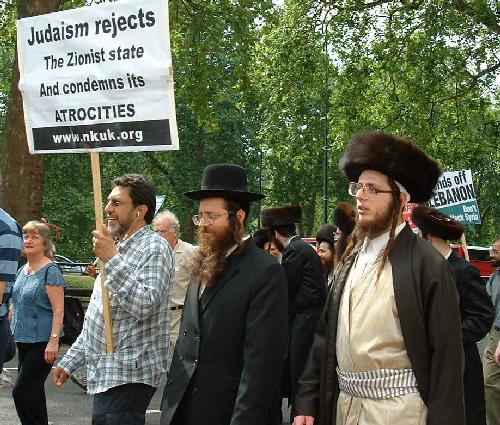
If we are to challenge anti-Semitism and anti-Judaic feeling we need to understand the multi-stranded nature of the bigotry. We also need to understand that the ideology of Zionism contributes to anti-Semitism, and the actions of the Israeli state make the world a more dangerous place for Jews.
We should not ignore the deep well of anti-Judaic ideology within Christian culture The huge success of Mel Gibson’s “Passion of Christ” reveals the large audience for the traditional Christian interpretation of the Gospels, that the Jews killed Christ. In the Gospel of Matthew, the Roman governor, Pontius Pilate “took water, and washed his hands before the [Jewish] multitude, saying, I am innocent of the blood of this just person: see ye to it. Then answered all the people, and said, His blood be on us, and on our children.” This may be a deeply unfashionable interpretation for trendy Anglicans, but it is believed by millions of Christians around the world. Indeed Mel Gibson was condemned simply for bringing the literal words of the Bible to a film-going audience.
In pre-Capitalist European culture, Christians were prohibited from usury – lending money for interest. Mediaeval Jewry therefore played a social role as bankers and financiers. The enduring stereotype of Jews as greedy therefore derives from Mediaeval opposition to finance capital. As Martin Luther wrote in 1543: “They let us work in the sweat of our brow to earn money and property while they sit behind the stove, idle away the time, fart, and roast pears. They stuff themselves, guzzle, and live in luxury and ease from our hard-earned goods. With their accursed usury they hold us and our property captive. Moreover, they mock and deride us because we work and let them play the role of lazy squires at our expense and in our land. Thus they are our masters and we are their servants, with our property, our sweat, and our labour.”
Martin Luther may have little direct influence on modern anti-Semitism, but the identification of Jews trying to control the world through finance capital still has widespread currency, and informs, for example the idea of a “Jewish lobby” that dictates American support for Israel.
It should be noted that neither the identification of Jews as Christ killers, nor the belief that there is a “Jewish lobby” can be identified as the new form of racism that speaks of cultural rather than racial differences. These are forms of anti-Judaic bigotry that pre-date racism, and are deeply embedded in European culture. To effectively challenge them requires that we recognise their origin, and specifically refute them in theoir own terms rather than confuse them as being identical with modern anti-semitism.
The 19th century saw anti-Judaic feeling given a gloss of pseudo-science, with the birth of this modern anti-semitism. This made an important difference because it created a racial category for the Jews. Previously Christian theology had disputed the claim of Jews to be a separate people. The Jews themselves regarded themselves as a nation without a home, but the Christians saw them as people who had rejected Christ. This was important for Christians as a refutation of the claim by Jews to be a favoured people by God. As Luther wrote: “If birth counts before God, I can claim to be just as noble as any Jew, … For I will not give it up and neither Abraham, David, prophets, apostles nor even an angel in heaven, shall deny me the right to boast that Noah, so far as physical birth or flesh and blood is concerned, is my true, natural ancestor, and that his wife (whoever she may have been) is my true, natural ancestress; for we are all descended, since the Deluge, from that one Noah.”
Mediaeval anti-Judaism regarded Jewishness as a question of faith, and a Jew who accepted Christ stopped being a Jew.( Indeed this was necessarily so, because the apostles were Jews who followed Christ.) Indeed the distinctive traditions of Hassidic Jews may have been adopted by the sect as a defence against their faith being lost by assimilation, in a similar way to Christian sects like the Amish. The concept of a secular Jew would have been a nonsense in Mediaeval Europe, whereas the Nazis slaughtered atheists and Christians who they regarded as being of Jewish race.
Through virtue of their alleged descent from a non-European linguistic stock the Jews became regarded as a race. The Zionists accepted this racialised identity. It is in this context that extreme modern anti-Semitism produced the idea of a Jewish conspiracy. It was also this context which saw the Zionists form a Jewish state, although Israel still has a problem deciding who is and who isn’t a Jew.
 This brings us to the third source of anti-Judaic sentiment today, which is opposition to the actions of the Israeli state. Particularly in the Middle East there is deep anti-Judaic sentiment, and they have imported modern anti-Semitism from Europe. The notorious forgery, the Protocols of the Elders of Zion, which “proves” the international conspiracy, is widely sold in the Arab world. The Iranian President Ahmadinejad hosted a recent conference in Tehran that denied the holocaust, and brought together assorted fruitcakes and Nazis, like David Duke.
Zionism started life as a strategy to escape anti-Semitism. Separatism has often been adopted by the oppressed, for example Marcus Garvey and the Black Train Home movement, or the Rastafarians. But through the existence of a Jewish state that systematically oppresses the Arab peoples, and through the acceptance by the Zionists of the need for racial separation, and the systematic identification of Israel with Jewishness, the Zionists are a major contributing factor to anti-Judaic feeling today.
But our opposition to Israel must not blind us to the rising tide of anti-Semitism, and the resurgence of older forms of anti-Judaic prejudice. Nor does it absolve the left of its responsibility to defend the Jews, we must never compromise our determined opposition to all forms of bigotry, even when challenging such bigotry is inconvenient.
 Last Saturday’s
  Then on the way to Embankment tube station I was privileged to see the bizarre spectacle of an Orange march, with assorted nut-jobs from all parts of these fair islands wearing their bowler hats and sashes, swaggering and beating big drums. When Gordon Brown talks of British values, this is presumably not what he means? But what else is there about Britishness? A fictitious national identity to forge together our island nations into an imperial project of bigotry, conquest and plunder.