Tuesday, October 10, 2006

More on those Sheridan tapes

By the way - I refer everyone to the best account of the issues I have read, by Martin Wicks.

Joaquín Bustelo has published a quite lengthy rebuttal on the Marx Mail list refuting my arguments about the Sheridan tape. It seems that some people find his arguments very convincing, and so here is a first draft of my response. I may amend and refine this as other comrades point out any shortfalls in my arguments.

Firstly I should express my stand point, I have never been, nor do I ever expect to be, a member of the SSP. I have no personal or political relationship with any of the individuals or factions within the SSP. However I do support the principle of broad socialist parties. I would be interested in why Bustelo is so partisan in favour of Sheridan.

Bustelo identifies the main axis of conflict as between Sheridan and the Murdoch press, with a seeming sub-text that the News of the World (NOTW) was engaged in an operation to destroy a socialist politician because he was a socialist.

This interpretation of events has a bearing on how appropriate it was for Sheridan to engage in court action. So we need to examine it.

Firstly the tabloid press in Scotland, Wales and England is indiscriminate, and has attacked the reputations of politicians from all parties. Deputy Prime Minister John Prescott; Leader of the Welsh labour party, Ron Davies; Leader of the Liberal Democrats Paddy Ashdown; former Chair of the Conservative Party, Jeffrey Archer.

Politicians have responded differently, Paddy Ashdown responded by saying it was none of the press’s business, and came out with his reputation enhanced. Conservative minister David Mellor cashed in on his notoriety to become a sports commentator. David Blunkett disastrously denied substantially true allegations and had his reputation destroyed, Jeffrey Archer and another conservative politician Jonathan Aitkin went to prison for perjury. And truth can also be liberating, as Ron Davies says in the interview I did with him: "Events have freed me up to be truer to my own beliefs"

Not only does the press attack politicians of all parties, but court action is not necessarily the best political response, and if the press allegations are true then it can be disastrous.

There is another question that engaging in court action exposes the Labour movement to judicial interference. When the Daily Mirror libelled miners’ leader Arthur Scargill, Scargill quite correctly relied upon a labour movement campaign of public meetings and publications refuting the claims. To have done otherwise would not only have exposed the NUM’s reputation to potential defeat in court, but also opened the books of the NUM to outside scrutiny, while they will probably have quite justifiably engaged in some (morally and ethically correct but legally dubious) financial obfuscation during their year long strike

Arthur Scargill has also been extremely careful during his career to give no unnecessary personal pretext to the press to attack him. Tommy Sheridan’s personal life is his own, but whatever political judgement we may make about swingers clubs and three in a bed sex, anyone who wishes to make those lifestyle choices should perhaps consider a less high profile political career. This may not be true in other countries or cultures, but in Scotland, Wales and England the press can and will relentlessly pursue a prurient agenda about sex, that is likely to overwhelm any other political message coming from that individual or his party.

So even had the NOTW allegations been entirely untrue, it is dubious that a court action was necessarily the best response. The advice of the party was for Sheridan to brave it out.

However, once Sheridan decided to initiate libel action this could not just be an action between Sheridan and the NOTW, it also inevitably entailed another dynamic – which was a conflict within the SSP. I find the argument that there was prior conspiracy against Sheridan totally unconvincing and unsupported by any evidence. However, given that there was a feeling within the party that Sheridan should not proceed, and given that a substantial minority at least believed there was some truth in the story, then proceeding with the libel action would inevitably damage the party.

Bustelo makes the remarkable claim that the evidence of the tape is that: “SHERIDAN DOES NOT ADMIT THE TRUTH OF THE NEWS OF THE WORLD CHARGES. On the contrary, he point-by-point refutes them. In this, the transcript is largely consistent with what Sheridan said in court” (Emphasis in the original)

The main thrust of Bustelo’s intervention in the debate is that the Sheridan tape supports Sheridan’s own account of the 9th November Executive Committee meeting, and that 15 members of the EC present who recall a different story are subject to some sort of cognitive dissonance due to factional hostility to Sheridan: “Basically, a majority of the NEC members had already whipped themselves up into a frenzy over this, convicted Sheridan in their own minds, and took whatever recognition of past indiscretions Sheridan laid before them at the meeting as an admission on his part that the first NotW article was true. Again, they could not or would not understand that Sheridan was saying that while indeed he had done some embarrassing and foolish things, the allegations in News of the World were not them. ”

This is the contention that needs to be addressed.

It is hard to refute Bustelo’s arguments because of the confused way he presents them. In general Bustelo’s article is hard to follow, because he does not set out his arguments and then marshal evidence to support those propositions, instead he jumbles up evidence and argument. But an important issue seems to be that he believes that because the NOTW article contained inaccuracies and specific lies, then this means that Sheridan is vindicated.

This seems to assume that Scottish libel law is the same as in America. Whereas in Scotland the defence of substantial truth can be used, which in fact is closer to the political reality. Politically it doesn’t matter if that or that detail is incorrect, if the overall thrust of the allegations is founded.

This perhaps explains why Bustelo (with no obvious context) introduces an account of how Anver Khan admits exaggerating her story, and also includes lengthy insert from another supporter of Sheridan describing the Fiona McGuire testimony, that are not directly relevant to the issue under discussion. Suddenly introducing a lot of detail gives an impression of rigour, but he does not incorporate the evidence to support his argument. Supporters of the SSP have never defended nor stood by the NOTW story. Yet Bustelo bases a lot of his argument on the idea that the inaccuracies in the NOTW article somehow wrong foot Sheridan’s opponents – this reveals his failure to distinguish between the two dynamics: Sheridan v NOTW, and Sheridan v the SSP.

The same approach of introducing a lot of technical evidence about the mechanics of tape forgery seems to give extra credibility to his discussion of the tape, but is not really relevant. At one stage he claims the tape supports Sheridan’s account, at another that the tape has been “sexed up”, and because he did not wait for the second instalment he is quiet over the tape’s dealing with Katrine Trolle’s evidence – that completely refutes his argument that the tape supports Sheridan’s account of events. Bustelo rather confusingly produces evidence that doubts the veracity and provenance of the tape, and then uses the same tape as evidence to support his argument.

Specifically Bustelo argues that Sheridan only admitted to previous sexual activity before he was married, and that the tape supports his claim that his visit to Cupids in 2002 did not happen. There are several problems with Bustelo’s account here:

i) He totally discounts the evidence of Katrine Trolle that supports the claim of the visit to Cupids in 2002. When he wrote his article Bustelo would have been unaware that the second instalment of the tape would include support of Trolle’s testimony, but he should have been aware that Trolle’s account given in Court was supported by evidence from her flat mates and her phone records. Her evidence is simply inconvenient and so it is ignored. This is consistent with Sheridan admitting to the meeting on 9th November that the story was true, as remembered by 15 of the 19 people there, but disputed by Joaquín Bustelo who was in another continent at the time.

ii) In the tape, referring to his earlier sexual activity, Sheridan says: “I've admitted that. That's out in the open. That's a matter of public record. ”, but when he described what he said to the EC he says: “I then make the biggest mistake of my life by confessing something in front of 19 f ***** g, what am I doing confessing in front of these c **** ?" ” had he only been repeating what in his own words was already in the public domain, why would he describe it as a confession and a mistake? Yet what Bustelo argues is that the EC majority confused an admission of previous activity with an admission that there was some substance to the NOTW story. He then claims that the EC may have “consciously distorted the written record of the meeting to depict Sheridan as having admitted the truth of the NotW article even though he was insisting they were false. ”

iii) Sheridan’s argument for why he should go to court are consistent with the EC majority’s claim that he intended to perjure himself. He says on the tape: “'I guarantee you if I am presented with incontrovertible evidence ? video tapes, CCTV, something of that character ? I'll put my hand up and say ?I'm sorry'...and I'll walk away. ”. Note that he is not denying that such incontrovertible evidence could be produced. Surely if the NOTW story was a pack of lies he would have said, there cannot be any evidence because it isn’t true.

iv) Why did the four comrades who subsequently remembered Sheridan denying the NOTW accusations vote for him to step down as convenor?

v) Given that the meeting was lengthy, and attended by 19 people plus Sheridan, it is inconceiveble that no-one would have sought clarification of exactly what Sheridan was admitting to. Yet this is what Bustelo would have us believe.

vi) Bustelo’s account simply fails on the basis of Occam’s razor. Instead of believing the most economical and credible account, to believe Sheridan means we have to accept the most far fetched and inclusive conspiracy, including Sheridan’s closest friends, the party leadership, et al.

With regard to the circumstances of the tape’s production and why it is only now in the public domain, Bustelo again asserts a conspiracy: “. Basically McNeilage, who was one of the three best men at his wedding, sandbagged and betrayed Sheridan, and is now running guns to the most despicable of lying bourgeois media outlets to use against a rival in the socialist movement. Do I believe this person did this all on his own initiative, independently of the anti-Sheridan faction in the leadership? Sure, I also believe in the tooth fairy and Santa Claus. ”

I don’t know George McNeilage, so cannot give any account of why he made the tape, but had the recording of the tape been part of a wider factional fight within the SSP, then the conspirators would surely have deployed it at an earlier stage which would have been to their greater advantage. It is entirely plausible that McNeilage made this tape at is own initiative. If we cast our minds back to that time there was intense speculation about what was happening in the SSP, and if McNeilage suspected that Sheridan was intending to perjure himself in such a way that the party would be damaged, he may have felt that he should record the conversation without being clear about his motives. Remember that Jeffrey Archer’s perjury was also revealed by a friend, Ted Francis, and his assistant Angele Peppiat, had been secretly recording evidence of Archer’s deceit. Again Bustelo prefers the melodramatic conspiracy explanation.

It is of course regrettable that McNeilage and now Katrine Trolle have cooperated with the NOTW. But remember that the Sheridan case has created enormous animosity, many of Sheridan’s closest friends feel a deep sense of betrayal, and Trolle herself was treated like shit in court, and is regarded as a non-person by Sheridan’s supporters who would rather ignore her evidence. The ill feeling and indiscipline in speaking to the tabloids is a consequence of Sheridan’s disgraceful behaviour, and in particular the hubris of his after court antics.

Finally, Bustelo puts a lot of smoke round the issue of whether or not the tape is reliable evidence. I don’t know and neither does he. However McNeilage vouches for the tape, and it is consistent with the evidence of 15 of the 19 people who attended the EC meeting, and it is consistent with Katrine Trolle’s evidence. What is more, the NOTW having already been stung with one lost libel action felt confident enough to publish it.

Monday, October 09, 2006

No one is illegal

The well-known slogan “Workers of the world unite” means what it says. It does not mean “Only workers with the correct immigration status unite”

SPONSOR/ATTEND TRADE UNION CONFERENCE AGAINST IMMIGRATION CONTROLS

SATURDAY MARCH 24th 2007

ASYLUM LINK, ST ANNES CHURCH, OVERBURY ST, LIVERPOOL 7

Opposing deportations and immigration detention is legitimate trade union activity. However fighting immigration controls is not charity. Controls weaken the labour movement itself.

* They split workers between “legal”/“illegal”, undermining wages/conditions
* They criminalise bosses for hiring undocumented workers and turn employers into Home Office spies. They bring controls into the workplace - encouraging immigration service raids
* They turn trade unionists into immigration officers demanding the immigration status of other workers. This happens in personnel offices at recruitment. It goes further. Most welfare – housing, hospital treatment, non contributory benefits – is linked to immigration status. So workers within local authorities, the NHS and benefit agencies must check immigration documents.

No One Is Illegal is a group of trade unionists long active in anti-deportation campaigns. We have produced with trade unions the pamphlet Workers Control Not Immigration Controls.

We want a conference based on open debate. We also think it important to discuss: * the amnesty proposals * how unions can campaign for recruitment of the undocumented *how the undocumented include more than refugees * what absence of controls would mean.

We ask union organisations to sponsor (give their name to) the conference and send delegates. Admission/ sponsorship free - donations welcome (cheques to No One Is illegal). Workers Control Not Immigration Controls can be obtained by donation (or downloaded at www.noii.org.uk ). We can provide a speaker.

Initial sponsors :
Trades Councils: Tameside, Oxford ,Bury, Waltham Forest. Union branches: Bolton NUT, Manchester Unison Community Health,

No One Is Illegal 16 Wood St, Bolton BL2 IDR, Email info@noii.org.uk

Friday, October 06, 2006

Organising Migrant Workers

UPDATE - over 70 Polish Migrant workers attended the launch meeting of the branch.

Given the racist hysteria recently in the press about migrant workers, it is good to see that the unions are responding in exctly the right way. During the otherwise unfortunate stewardship of Kevin Curran the GMB showed exemplary leadership in the Somerset town of Chard in organising both white british and Portuguse migrant workers at the Oscar Meyer factory, in the process undermining a racist campaign in the town.

There is a danger that empoloyers will use migrant workers to undermine wages and conditions, and it is the unions job to send a clear message that migrant workes are all welcome here; and we will not tolerate bosses employing them on worse terms and conditions. That can only be aceived in one way - shop floor organisation and directly recruiting migrant workers into our unions so that we can stand together.

The GMB has now passed an another importnat milestone and is launching its first trade union Branch dedicated to the needs of migrant workers in Southampton tonight. At present the Branch is mainly catering for Polish workers employed in the security industry in but will be extended to cover the estimated 30,000 polish workers in and around Southampton. The Branch will provide language training, job training and work placements.

According to Alan Frazer, GMB Organiser, “We have been representing migrant workers more and more in recent years. We have found that need different things from native workers and so this dedicated Branch will provide that service. GMB will be extending this initiative across the south east and nationally..

The GMB also organises Polish workers at The American Dry Cleaning Company in Colindale London; and in the East Midlands where two fulltime GMB Organisers (who are themselves migrant workers) recruit and organise migrant labour in horticulture, farming poultry and food processing.

The GMB has also negotiated and signed two national agreements in the off-shore industry with CAPE Industrial Services and AMEC which ensure that migrant workers, nearly all who are Polish are paid the national agreement rate for the job, have the correct training and skills levels and are not discriminated against over any element covered by the national agreement rates and terms.

The T&G is also making efforts to organise migrant workers - particularly in the agricultural sector.

Thursday, October 05, 2006

Statement by Colin Fox on behalf of SSP

After accusing the SSP executive of fabricating minutes and orchestrating "the mother of all frame-ups", Tommy Sheridan is now accusing the party of colluding with News of the World and MI5 to produce a fake video confession.This is an absurd and fantastical allegation that will be treated with astonishment by most people in Scotland. In fact, the tape is clearly authentic and blows apart Tommy's preposterous allegations against his old party comrades. The tape establishes, from Tommy's own mouth, that our 11 comrades, who were forced under threat of imprisonment to give evidence to the Court of Session, told the truth.
Contrary to the latest chapter in Tommy Sheridan's science fiction novel, the SSP had no involvement in the production of this tape. George McNeilage is an SSP member, but holds no position within the party. He taped this conversation as a private individual and as a former close personal friend of Tommy Sheridan.
The SSP does not advocate or practise the secret taping of conversations. The SSP had no knowledge of or role in the production of this tape.We have sought to build a political movement based on mutual trust - though we also recognise, with the benefit of hindsight, that Tommy Sheridan has been prepared to trample all trust into the dirt for his own personal ends.
Nor is it true, as has been falsely claimed by supporters of Tommy Sheridan, that the SSP handed this tape over to News of the World. The SSP EC has never had possession of this tape; nor did the SSP have any involvement in passing the tape to the newspaper. Neither the SSP nor any of its office-bearers have received or will receive a single penny from News of the World or from any other media company - unlike Tommy Sheridan, who was recently paid £30,000 by the New Labour-supporting media corporation, Trinity Mirror, for denouncing his then comrades as "scabs", "liars", "rats" and "perjurers".
We believe that events are now rapidly approaching a conclusion that will have seriously damaging consequences for Tommy Sheridan and his breakaway political organisation, Solidarity, founded on the basis of a lie and fraud.History will judge Tommy Sheridan's libel action as one of the biggest political misjudgements of modern times and will vindicate the judgement of the 2004 SSP EC, who advised a different course of action.
With a perjury investigation now underway, we are confident that the good name of the SSP will be restored 100 per cent. We can now start to draw a line under the past and move forward, establishing new branches, recruiting new members and winning support by engaging in the many campaigns for social and economic justice emerging across Scotland.
We have in recent weeks renewed our commitment to the anti-war movement and to the rapidly developing struggle for Scottish independence.We will continue our campaign against nuclear power and nuclear weapons.
Our party was built and will grow further around the principle of showing practical solidarity to workers and communities in struggle. We believe that if the SSP continues to look outward and engage with working people in their day-to-day struggles we can quickly recover any ground we have lost as result of the calamitous actions of Tommy Sheridan.

Latin America still steering left


The advance of the left in South America continues. On the main Socialist Unity Website there are two interesting articles. One by Hal Weitzman in Latacunga, Ecuador, reports the progress of the hard left presidential campaign of Rafael Correa, who he quotes as saying: “The political and economic elites have stolen everything from us, but they cannot steal our hope … We will take back our oil, our country, our future.” With less than two weeks to go until the October 15 elections, Mr Correa’s support has risen quickly to 33 per cent, against 22 per cent for León Roldós, the centre-left winger who is his nearest rival.

Also very significant is the strong showing for hard left candidate Heloisa Helena, in the recent Brazilian election. Jim Jepps, wrote the following very interesting article.

The first round of the Brazilian elections has just taken place and, as long as you read Portugese you can see a detailed breakdown of results
Lula's scandal hit presidency failed to get the required 50% to win outright this Sunday, he did still maintain a convincing lead that may give his camp confidence that he will win the Presidency in the second round but although Lula only needs to gain an extra 1.4%, there are no guarantees that voters for other parties will turn to him next. After all it is not so long ago that polls put his lead at over 20% and his camp was confident they would win in the first round of the ballot.


Lula set the tone early in his Presidency by slashing pensions for public-sector workers by 30 percent, cutting spending for health and education by 5 percent, and pushing through legislation making it easier to fire workers. The government has been characterised by neo-liberal policies and a succession of scandals, including those of political corruption, but many still see Lula as the 'lesser evil' because of his background as a factory worker, the government's programme of relief for the very poorest and the Worker's Party's (PT) roots in social movements. Movements they have long since abandoned.


The top three Presidential candidates were:
Lula 48.61% PT President running a scandal hit neo-liberal government
Alckmin 41.64% From the traditional right
Heloisa Helena 6.85% Hard left P-SOL candidate


Alckmin, who campaigns wearing designer clothes and makes much of his friendly relationship with business elites, was not expected to perform so well at the polls - but his election propaganda in the last few weeks has begun focusing on the corruption of the current government and to some extent has played upon Alckmin's bland image as a counter to the flamboyant, but "corrupt" Lula. This was further bolstered when two weeks before polling several campaign aids to Lula were arrested on charges connected with bribery.
This approach has worked, despite some of the more alarming aspects of Alckmin's programme like promising a "management shock" to slim down the federal government, funding massive tax cuts by reducing public spending and more "market friendly" policies. His campaign was also hit by organised and violent attacks in Sao Paulo where around 200 people were killed.
A big winner of this election was Heloisa Helena of P-SOL who was one of the senators expelled from Lula's Workers' Party (PT) in 2003 for speaking out against its neo-liberal policies. Helena, a former nurse, has refused to support Lula in the second round, after all when the choice is between two pro-market candidates it's difficult to come out and 'support' one against the other.
She said "That would be ripping 12 years of history and political fight against the neo-liberal project of the PSDB and against the party clique that Lula's government has turned into. Our voters are free men and women. They do not need our indications to choose who to vote for."
P-SOL managed to gain the support of the main left groupings in Brazil in the run up to the election and it is hoped that this will see the start of a more long term re-groupment on the left, a hope bolstered by the relatively good result. Whilst Helena's campaign has lacked the funds and the media coverage of her rivals it also stands in a tradition that potentially speaks to millions in Brazil.
She recently told an interviewer that "What we want is the democratization of the wealth, culture, health and education. We are not heirs of the tradition of totalitarian European socialism. I do not defend socialism by decree. I do not want totalitarian socialism, nor only capitalist thinking. In Brazil, capitalism has been very ugly, cruel and violent."
Over six and half million people voted for Helena in this election a truly outstanding achievement for a candidate of the hard left.
Within this result there are some interesting points. Helena performed most poorly in the Lula strongholds, rather than bastions of the right, so for instance in Ceara, Maranhao and Pernambuco, all areas where Lula polled more than 70%, Helena polled 3.79, 2.86, and 3.74 of the vote respectively. Considering these are the three lowest results for a far left candidate in the entire country it's not at all bad.
On the other side there were some very good areas. In Algoaes (where she was a senator for several years) she polled 13.3%, in Amapa, Distrito Federal and Roraima she polled 10%, 12.3% and 11.7% respectively whilst in Rio De Janeiro she polled an impressive 17.1% which is about 1 in 6 of those who voted.
The achievement of this election campaign lies not only in creating the head of steam required for large sections of the population to give you a hearing, or gaining the support of so many millions at the ballot box but also in the successes in bringing together core sections of the left in one unified campaign that articulated the demands of the social movements and those who call for an socialist alternative to the free market dogma that dominates Brazil, as it does the rest of the planet.

Wednesday, October 04, 2006

the philosophical roots of sectarianism

If you remember a while back, I referred to a debate on Dave Osler’s Blog whereby leading SWP blogger, Lenin, rejected the idea that objective truth exists, or rather that it can be approximately knowable. This is a fundamental rejection of a key tenet of Marxism. There has been a contribution to a similar debate in last week’s Weekly Worker, but sadly the article by "Chris Knight" in defence of science is a bit disappointing. Thanks to Matthew at The point is, for bringing the article to my attention.

The argument becomes a bit technical, but worth persevering with, as it is relevant to the whole situation we are in with competing left groups all proclaiming they are the way, the truth and the life.

Knight says: "In the final analysis, no doubt, the proof of the pudding is in the eating. What happens when we try out a new hypothesis? Does it prove to be empowering? Does it lessen mental effort in solving intellectual problems? In other words, does the hypothesis add to the power - be it purely intellectual or practical as well - of scientists in the relevant field? If it does, then everyone should ultimately come to recognise the fact. Assuming intellectual efficiency to be our criterion (and we will not be scientists otherwise), support for the theory will spread. Internal coherence (agreement between the theory’s parts) will find expression in widespread social agreement. Such a capacity to produce agreement is the ultimate social test of science."

This type of argument in defence of scientific realism was dealt a body blow by Laudan's theory of "pessimistic induction". Laudan basically points out that using tests like the one by Kuhn approvingly quoted here, lots of false theories like the phlogiston theory of chemistry or the caloric theory of heat, were accepted as truth.

To say that "capacity to produce agreement" is the arbiter of truth-likeness, is a dangerous concession to the idea that truth is only what we agree it to be. Indeed “Chris Knight” concludes: “ if Marxism is genuine science, it ought to be possible to demonstrate this potential in purely theoretical terms in advance.” Thus he rejects not only the philosphical position of scientific realism that the predictive powers of theories must be empirically established, but also the actual practice of working scienctists that hypotheses are not accepted unless they are repeatably verified by experiment

Before we go any further it is worth stating what the scientific realist philosophical position, (which is defended by but not exclusive to Marxists) actually is. In a nut shell we argue that currently successful scientific theories are approximately true. In the evocative image by the philosopher, Sellars, scientific theories are “cutting the world at its joints”

This is worth looking at because if a prolific writer in the SWP, like the blogger “Lenin” argues that the truth of concepts such as atoms is unknowable, then all truth is unknowable, and all we have is language. In which case we are in the very scary world where the truth is determined by power relations, and where the ends totally justify the means. Only recently in the comments box of the Sheridan story in this blog, SWP blogger Snowball referred to "the truth” in question marks. As Ed correctly says in reply: “the position you're taking here is reminiscent of those references to 'revolutionary truth' (ie what it is politically expedient to promote as the 'truth') as opposed to 'bourgeois truth' (as in what actually happened) which have unfortunate historical associations”


(skip the next two paragraphs if you are not interested in philosophy) Laudan actually made an important contribution to the defence of scientific realism by attacking a weak chink in some interpretations of it, and therefore refining how we interpret evidence. Laudan correctly points out that when it comes to observing scientific theories, observing their consequences is neither necessary nor sufficient for empirical support. That is not all logical consequences of a hypothesis are supportive (for example quick recovery from a cold after prayer would not prove the hypothesis of the power of prayer), and conversely a hypothesis can be supported by evidence not among its logical consequences (If a theory T entailed some evidence E, then if T was part of a wider theory H, then E indirectly supports H, even though E is not entailed by H)

Thus Laudan challenges naïve empiricists who would argue that if there are two theories T and T’ that both explain the evidence E, then the best we can do is argue that the theories are empirically adequate, and we cannot distinguish if either is approximately true. In defence of scientific realism (supported here by Laudan) we must say that theories that explain the empirical evidence must also conform to theoretical virtues, such as coherence with other established theories, completeness, unifying power and the capacity to generate novel predictions.

So is Marxism a science? To which I would answer it could be, but usually isn’t. If we mean by Marxism a social theory that seeks to establish its own approximate truth through examination of the evidence, and through self-critical evaluation of its own theoretical virtues, including coherence, then Marxism is a science. However, there must be a number of caveats. Firstly, that the development of evidence involves the art of seeking to change the world though political activity, and it is extremely hard to evaluate the impact of such activity, and what evidence is gathered is subjective . Secondly, the research resources of the Marxist left, including academics, are puny compared to the complexity of the society we are seeking to understand, so any theories we develop are likely to be only highly flawed approximations to the truth; thirdly the problem of organisational conservatism on defending false aspects of theories. When we take these caveats into account we can see the inadequacy of all those arguments that start: “As Marxists we should, or as Marxists we must … “

The last factor I mention, organisational conservatism is perhaps the most important. Precisely because the empirical evidence is sparse, or subject to other interpretations that are equally consistent with the evidence, then the question of “theoretical virtues” are of elevated importance. Alex Callinicos includes a useful discussion of this in his short book on Trotskyism, discussing the question of progressive and regressive problem shifts derived from Lakatos. If the consequence of a theory entails evidence consistent with an unrelated theory then this is a progressive problem shift, that supports a presumption towards truth-likeness. If however, defence of a theory involves rejection of parts of other mature ands established theories, then we are involved in a regressive problem shift (That doesn’t necessarily mean it is wrong as all theories are only truth approximations and can be refined – but a regressive problem shift should raise a presumption of truth-unlikeness requiring further research.)

Yet the various Leninist groups, the SWP, CWI, USFI etc, all derive their justification for separateness by defining themselves as having a coherent world vision based upon a unique or semi unique interpretation of Marxism, often deriving from very partial and incomplete evidence. How could it be different? How could a few amateur researchers, with scarcely any access to evidence, really develop theories that were sufficiently supported empirically; and sufficiently theoretically virtuous in the technical sense; to explain social phenomenon as complex as the degeneration of the Soviet Union? Yet on the basis of these differing interpretations, each of these groups has developed a distinct Weltanshauung that is largely hermetically sealed. For example, if we look at the theoretical writings of the IS tendency, they only refer to works within their own “tradition”, or to the old grey beards. The same can be said of the Mandelite tradition, or the Taafeites. In other words, the left groups deliberately eschew an attempt to develop a scientific exposure of their theories to a discussion of their theoretical virtues – again in the technical sense of what degree they are consistent, consilient, lacking ad hoc features, etc.

This is because each of these groups endeavour to establish that their theoretical tradition, and their reason for separateness, is and always has been correct. What is more there is a belief that the tactical decisions of the leadership bodies are always correct or defensible – but why should that be so? This is not a scientific realist approach, and inevitably involves regressive problem shifts, and increasing cognitive dissonance.

How insane we must look from the outside. A tiny number of dedicated socialists, spilt into multiple organisations, each of which believe they are the only ones with access to the truth.

Monday, October 02, 2006

A nation once again?


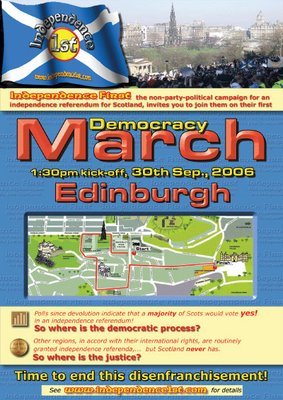
There is a very interesting report on Kevin Williamson’s blog about the march in Edinburgh last Saturday in support of Independence. It includes a You Tube video of the demonstration. Note in addition to the SSP banners and placards a big “Solidarity” banner.

It is worth reading the important article by Murray Smith on the National Question in western Europe, where he explains why support for independence is not nationalist:

“The support for Scottish independence seems to be stronger rather than weaker, the difference being that no one party can any longer claim to be the sole representative of independence. In Wales, the leadership of Plaid Cymru was always a bit bashful about independence, resorting to circumlocutions like 'full national status'. But after the setbacks the party experienced in the May elections a new leadership has taken over and the recent conference of the party came out massively and noisily for independence. At the same time Plaid denounced Labour for having abandoned "all its old socialist values in favour of creeping privatisation".
"There are certainly reasons inherent in the Welsh situation which help to explain this evolution, in particular the shift to the left of the Welsh Labour Party. But if the support for independence is stronger and Plaid has moved to the left it is also because of the example of Scotland, where the situation is more advanced. And in coming out clearly for independence and taking up a position to the left of Labour, Plaid is following the example of the SSP rather than the SNP, which is now abandoning such a position in favour of neoliberal policies.
"The question that is posed, and posed very concretely in Scotland at the moment, is not just the issue of independence, but of what independence. It is posed for those who are already in favour of independence, but it is also vital for winning over those who are not yet convinced. It is worth recalling at this point that 'independence /national movement' does not equal 'nationalism'. That would be to confuse a political objective with an ideology. Miroslav Hroch explains: "the current tendency to speak of them (national movements, MS) as 'nationalist' leads to serious confusion. Because nationalism in the strict sense is something else: namely, that outlook which gives an absolute priority to the values of the nation over all other values and interests" (emphasis in the original)


"Independence is always concrete. It leads to the creation of states and states have a class character. That is why it is when independence becomes a real possibility that national movements begin to crystallise into different currents, as is happening in Scotland today. The SNP is a nationalist party, which is furthermore in the process of seriously watering down its commitment to independence, in the framework of its rightward evolution. The SSP is a party that rejects nationalist ideology, which is internationalist but which aims to be the best fighter for Scottish independence, while giving that independence a socialist content. It is from this position of strength that the SSP can support the idea of a pole for independence in the shape of the Independence Convention, which will put the SNP leadership in contradiction with part of its own supporters."

Sheridan's web of deceit


Yesterday’s release by the News of the World of an audio tape of Tommy Sheridan admitting that he told the SSP executive on 9th November 2004 that the allegations against him by NOTW were substantially true comes as a bombshell, not only for Sheridan but also for his supporters in the SWP and CWI. The denials by Sheridan and claims that the tape is a forgery seem far fetched.

Of course it is regrettable that this tape has ended up in the hands of the NOTW, and questions need to be asked about how this happened. But we must resist attempts to blow smoke around the political issues, as the questions of whether the tape is genuine, and how it ended up with the NOTW are side shows.

The real issue is that the tape confirms the evidence given by the 11 SSP witnesses who reluctantly testified at Sheridan’s libel action. Sheridan also confirms in the tape that he stated his intention to deny the allegations, because he believed the NOTW had no proof.

This is at the heart of the dispute that has led to the split in the SSP. The party recommended that Sheridan ride out the storm, but instead he was determined to sue the NOTW, despite the fact that this would involve perjury. The Executive Committee meeting on 9th November unanimously voted to ask Sheridan to step down as convenor, because this was a disastrously risky course of action for the party. The only SWP member at the meeting, Pat Smith, voted for the decision to ask for Sheridan’s resignation, but has subsequently changed her mind.

The SWP admits in the latest IST document (PDF) to concerns by the SSP leadership about "the way in which Sheridan intended to defend himself in court could have had damaging implications for the party as a whole.". Which gives further credence that the SWP do not substantially challenge the facts.

Instead the SWP argue that the comrades had a class duty to back Sheridan in court. But this was a very risky strategy, not least because it would forever hold the party hostage. On the Sunday 18 June 2006 the EC voted that those SSP members now cited as witnesses in the libel action should go to court under protest but neither perjure themselves nor place themselves in contempt of court. These were witnesses that had opposed the libel action being commenced, and were being reluctantly called by the NOTW. Two SWP EC members voted against this policy on 18th June, but offered no alternative strategy. Let us run that by again. The SWP EC members voted against telling the truth in court! Of course they didn't propose an alternative strategy, as this would have been a prejudicial admission that they might be intending to commit a criminal offence – of conspiracy to pervert the course of justice.

What is more, in order to contradict the evidence of the 11 SSP witnesses who told the truth about what was said on 9th November, Sheridan and his supporters have been required to invent the political slander of a “conspiracy” against Sheridan.

As we now hear on the tape, Sheridan admits “I then make the biggest mistake of my life by confessing something in front of 19 f ***** g, what am I doing confessing in front of these c **** ?”

But this is what SWP member, Pat Smith, who was at the 2004 meeting testified in court. When asked by Sheridan (representing himself in court) whether he had denied visiting the Cupids night club, Pat Smith, said: "You were very, very clear about that." When asked why 11 other witnesses remembered Sheridan saying it, Smith replied "I can only think it was done for negative reasons."

Why am I concentrating only on the SWP witness, and not on the other 3 witnesses who backed Sheridan’s account of the meeting? Well, because of the issue of democratic accountability, Pat Smith would not have been acting alone, her decision to testify in the way she did will have been made by the SWP leadership. Indeed, why else call upon A-list SWP cadre Mike Gonzales to testify in support of Sheridan – when he hadn’t even been at the November meeting. Because Gonzales was not at the 9th November meeting he probably did not perjure himself, and his testimony was largely irrelevant, but he did give moral and political support to Pat Smith by testifying.

A political decision was made by the SWP to back Sheridan’s court action, against the interests and expressed wishes of the SSP. What is more, the political basis of the court action was entirely reactionary. It was not a defence of Sheridan’s privacy, but an attempt to defend a false image of Sheridan as a perfect family man – Victorian double standards.

Having decided that they would continue with that position up to the point of perjury, the SWP supported the claim of a conspiracy. In contrast, one other pro-Sheridan witness, Rosemary Byrne MSP, when asked in the Witness box whether MSPs Colin Fox, Carolyn Leckie and Rosie Kane — were lying, she replied: "I'm very, very wary of calling people liars.". She stepped back from accusing them in court of perjury, but Pat Smith had no reluctance to say in court that the 11 witnesses were lying, recklessly exposing the 11 to prosecution for perjury and a potential prison term. (In answer to the question, aren’t I dong the same thing – well the established fact is that 11 witnesses gave evidence on way, 4 gave evidence the other, so the fact of perjury is undeniable and already in the public domain, the responsibility for which lies with Sheridan and his supporters who did not need to go to court in the first place. There can be no progress without truth, so there does need to be a serious discussion about the politics behind the decision to lie in court.)

Having embarked on a course of perjury and false accusations of conspiracy against the SSP leadership, the SWP and CWI are hoist by their own petard. They can never admit the truth, either publicly or to their own members, without further exposing their own comrades to criminal prosecution. This disregard for the truth is morally and politically corrupting. This trap could have been avoided, and the leaderships of the SWP and CWI were reckless in exposing not only their opponents in the SSP, but also themselves and their own organisation.

On a more encouraging note, it seems that the RMT affiliation is staying with the SSP, and not going to Solidarity.

Saturday, September 30, 2006

Turn off the oil


Following the Socialist Resistance AGM, which I attended as an observer, I was asked to write a short article for their paper about the war in Lebanon. Here is a sneak preview.

The recent war has been a disaster for Lebanon. Some 5000 dead, accompanied by destruction of the country’s economic infrastructure, an environmental catastrophe due to oil pollution, and the area south of the Litani river covered in cluster bombs. The responsibility for these atrocities lies with the Israeli Defense Force and its political masters. Nevertheless, Hezbollah also made political and military choices.

It has been transparent since 1973 that the USA will not allow Israel to suffer any catastrophic military defeat. Significant early advances by the Syrian and Egyptian armies during the Yom Kippur war were reversed by Israel only with massive US military support. What is more, there has also been a long tradition of guerrilla attacks on Israel being used to enhance the political and military prestige of competing Arab forces. For example, the promotion of guerrilla actions by Fatah during the 1960s, funded by Saudi Arabia, to undermine the Nasserite leadership of the PLO, and indirectly undermine the authority of pan-Arabism. There has also been a tradition, particularly during Yasser Arafat’s leadership of the PLO, of bargaining the suffering of civilian targets of Israeli aggression to gain diplomatic advantage.

The events of 12th July 2006 on the Israeli-Lebanon border will always be in dispute. It is entirely plausible that the IDF were anyway planning an attack on Lebanon. Nevertheless the nature, scale and ferocity of the Israeli response to Hezbollah’s military action would have been known to the Hezbollah leadership in advance. The fact that Hezbollah troops were dug in and had rockets deployed suggests that the action was a deliberate precipitation of war by Hezbollah.
The military defeat has created a political crisis for Ehud Olmert’s government, but it has not caused a general crisis of confidence in the Zionism, nor in a general questioning of the IDF’s capability. The confidence of Israel remains intact for the simple reason that the war did not undermine the central cornerstone of their defence, which is the backing of the USA.

No military or political struggle will prevail against Israel unless it also threatens the USA, which leads to a very simple question. Why was no voice raised in the Middle East calling for oil production to be halted? Even Hezbollah’s greatest ally, Iran, did not use its economic power.
In contrast, in 1973 the OPEC producers scaled production back 5%, then 10%, and then Abu Dhabi responded to President Nixon’s granting of $2.2 billion of military aid to Israel by initiating a total oil embargo. The embargo lasted for 6 months before Saudi Arabia broke the strike.
American domination of Middle East oil has rested on two pillars, unconditional support for both Israel, and the House of Saud. Having the Saudis as allies inside the Arab tent has decisively diverted the direction of Arab politics, but the House of Saud have also had to respond to their own pressures.

A crucial difference between 1973 and 2006 is that within the Arab world both the political left and Pan-Arabist nationalists have been substantially defeated. It was the Egyptian leader, Gamal Abdel Nasser who promoted the idea of "Arab oil for the Arab people", and was a constant threat to the Saudi monarchy. In 1955 there was an attempted uprising by pro-Nasser Saudi officers in Taif, and another attempt in 1956 in Dhahran, and in 1956 fifteen thousand oil workers went on strike in Arabia chanting Nasseite slogans. With CIA help the Saud family undermined Nasser both drawing him into a protracted proxy war in Yemen, and also undermining Nasser’s international prestige by promoting Fatah as leaders of the Palestinians.
Nevertheless, in 1973 King Faisal was under sufficient pressure from his own population, and was sufficiently fearful of Egypt’s new President Sadat reverting to Nasserism, that Arabia played a leading role in using the oil weapon to attack US support for Israel.

Pan-Arabism was historically defeated because it was predicated upon Arab states playing the super-powers, including Britain in the 1950s, off against each other; and this is no longer possible; also because of rivalry between the different Arab elites, for example between Nasser and Kassem of Iraq, about who would be the leader of the united Arabs. But most importantly, because the power of pan-Arabism lay in its ability to inspire the Arab workers and peasants that national unity would lead to solving their day to day impoverishment and misery. Yet awakening the working classes was the last thing the Nasserites or Ba’athists would ever do.
Zionism cannot be defeated without threatening the link between Israel the USA, and the key to isolating Israel is to use the economic power of the oil producers. Yet that oil is controlled by corrupt elites who depend on US support to survive. The task of the left is not to cheer lead for the Hezbollah, but to raise again the demand of Arab Oil for the Arab people, and to demand that the flow of oil be turned off in response to Zionist aggression.

Friday, September 29, 2006

Scottish Socialist Party alive and well

MSP Frances Curran's bill for a free nutritous meal for every Scottish school child is just starting its journey through parliament in Edinburgh. This exemplifies what the SSP is all about - a campaigning party that is looking not only to socialism some time in the future, but also campiagning for practical socialist measures now that will bring improvements to the lives and health of working class people here and now. If passed this bill will transform the health of Scottish children within one generation. To learn more about the details of the Bill, the consultation document produced in the run up is a good source of information. (PDF)

I will write more about the bill later, but it is worth looking at the state of the SSP after its recent difficulties . KEN FERGUSON - Convenor of Tay Coast SSP - wrote the following article in yesterday's Morning Star.

SINCE its formation as a unified socialist party, the SSP has inspired thousands not just in Scotland but in the movement across the world. Growing from several roots, the SSP was formed out of the Scottish Socialist Alliance and was a serious attempt to bring a range of different socialist traditions together in a left-wing version of "big tent" politics.

It attempted to combine parliamentary and extraparliamentary politics together in what was not either an electoralist or a vanguard party but what was described as a "combat party."
The SSP can be found opposing closures, supporting strikes, opposing motorways, backing communities against NHS and council cuts and fighting elections.

The process was given a major boost by the fact that, throughout the Thatcher years, Scotland resisted her agenda and, although this happened elsewhere, in Scotland, there was the added dimension of the national question. The savage attacks, from pit closures to the poll tax, which was trialled first in Scotland, had both a social aspect and, increasingly, a national dimension.
Put simply, parts of the left asked the question, if Britain wants Thatcher and we don't, why not back an independent Scotland?

Readers should understand that the call for a parliament dealing with Scottish affairs goes back to the pioneers of Keir Hardie's time and that the modern campaign was led by the STUC.
The victory of Tommy Sheridan in the first Scottish Parliament, followed four years later by that of six SSP members, was a direct consequence of the more democratic electoral system used in Edinburgh. This is similar to the list system used in Germany, which gives parties seats if they gain a certain percentage of votes across a region.

The events of this summer, with lurid sex headlines culminating not just in Sheridan's court victory but in an organised attempt to wreck the SSP, have put much of this at risk.
However, the initial evidence suggests that, despite highly opportunist backing from both the SWP and the CWI, the misnamed Solidarity looks likely to fail.

The vast majority of members stayed with the SSP, with organisation in the key central belt solid. The party is turning outwards and is about to table a key Scottish Parliament Bill for the provision of free school meals which has won widespread support from medical, educational and campaigning groups.

The latest post-split opinion poll put the SSP on 6 per cent, just one point below its winning level of 2003. The party is also showing signs of opening up education and policy making and this more open approach is likely to win support at the SSP conference in early October.

There is also the question of what direction the non-Labour radical forces will take, particularly in the current context of rising support for independence, with recent polls now showing a majority of Scots voters supporting it. The right-wing offensive inside the SNP has seen a considerable softening of its previous left positions, with the adoption of a heavily pro-business posture while retaining opposition to Trident and the Iraq war.

In an uncanny echo of the birth of new Labour, the "new" SNP has been vying with the new Labour/Liberal executive to prove who can manage the status quo most effectively.
The SNP leadership will also put independence on the back burner, with demands for an independence referendum now coming at the end of a SNP government's first term. The thinking seems to be that, if the voters see it running the devolved services first, they will trust it with an independent state.

With the Scottish Greens actively courting a place in any post-2007 election coalition with either the Scottish National Party or new Labour, left greens have much to ponder. They have to square working with a government which, on the one hand, proclaims its "green" credentials in support for renewable energy while, on the other, building motorways and bankrolling air travel growth.

The reality is, as the SSP argues, that you need to be red to be green. In other words, only a challenge to planet-trashing corporate power can lay the basis for green collective solutions on issues such as energy supply, public transport, health and housing.

Free school meals are a shining example of this approach.
A recent report showed that 10 years of healthy eating helplines, food tsars, advertising and advice on food content have had virtually no impact on Scotland's bad health record.
Yet, where a policy of providing free, nutritious school meals was adopted in Hull, the take-up rate went from 36 per cent to 64 per cent.

SSP MSP Frances Curran is piloting a Bill in the Holyrood parliament to introduce free school meals and it will be interesting to see how much support is forthcoming from the parties who daily lecture us about children's eating habits.

The politics of the period between now and 2007 - the 300th anniversary of the union treaty setting up the UK Parliament - will be highly fluid and unpredictable. Which way will the Lib Dems, the India rubber men of Scottish politics, jump? Can new Labour halt its current downward spiral with Blair at the helm?

For pro-independence socialists and radicals, 2007 can be the moment when we break the blood-stained imperialist British state, meeting the democratic needs of Scots and punching a hole in the current pro-war forces led by Bush and Blair.

However, to win this, they will have to put aside illusions about alliances or deals based on pro-market ideas, work patiently for an agreed way forward and for policies which challenge the pro-business, pro-war agenda of the current Scottish Executive.

Thursday, September 28, 2006

Peterloo Rally of Resistance

...


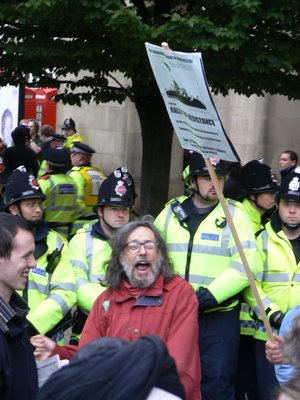
Yesterday's Stop the Warmongers event in Manchester received an extreme police over-reaction. Stop the Warmongers was formed by Manchester peace activists partly in response to the national Stop the War Coalition's decision to overrule their preference for a Sunday national demonstration (the day Labour conference actually started), but then grew as an umbrella group organising a series of protests and events throughout the week of Labour party conference.


The brutal over-reaction of the police seemed to take a lot of people by surprise - even in the Orwellian new Britain that we now live in. There was a large number of journalists there (mostly after 2pm, when the protest had already informed the police that it was willing to disperse, but the police wouldnt let it). they were visibly shocked, especially the ones that the police wouldn’t let in or out of their cordons.

The police wanted the protest to take place in the confines of the "peace gardens" (an undefined area that they had decided extended to a point about 10 feet nearer the statue than we were gathered). Without any notification to us, they then blocked the way to this space, so it was no longer possible for the protest to move there.

Then they surrounded the protest (at the point when those with small children had left, there were at least 150 police officers and 46 protestors contained by them). the protest made the offer of dispersing at 2pm was relayed to the chief inspector, Stuart Barton. he immediately refused this offer and insisted that the protest remain there till 2.30. he also then had the legal observer removed from his presence (who had until then been virtually instructed by the police to talk to him on a regular basis).

The police appear to have arrested two people - one elderly, disabled woman, who was carrying a placard and may have been goaded by a woman police officer as she left, and another young man who was not part of the protest at all but had been shopping with a friend and walking through the square and may have been arrested for swearing at a police officer. there were a couple more incidents where people thought other police officers were trying to take their details or detain them further but these appear to have been by police not part of containing the protest (eg the "regular" presence on the trams etc).

Wednesday, September 27, 2006

Before the Taliban


It is the tenth anniversary of Afghan capital. Kabul, falling to the Taliban. It is worth noting that the Taliban did not take power until seven years after the Russian withdrawal. By 1996, half of Kabul had already been destroyed by the mujahideen, who had been armed and supported by the USA. Tens of thousands were killed in fighting over the city.

Today Afghanistan is in the grip of warlordism and terror. Human Rights Watch has described the atrocities:: "committed by gunmen and warlords who were propelled into power by the United States and its coalition partners after the Taliban fell in 2001" and who have "essentially hijacked the country". The report describes army and police troops controlled by the warlords kidnapping villagers with impunity and holding them for ransom in unofficial prisons; the widespread rape of women, girls and boys; routine extortion, robbery and arbitrary murder.

The report by Human Rights Watch spells out a desperate situation for education in Afghanistan. “Schools are being shut down by bombs and threats, denying another generation of Afghan girls an education and the chance for a better life. Human Rights Watch found entire districts in Afghanistan where attacks had closed all schools and driven out the teachers and non-governmental organizations providing education. Insecurity, societal resistance in some quarters to equal access to education for girls, and a lack of resources mean that, despite advances in recent years, the majority of girls in the country remain out of school. Nearly one-third of districts have no girls’ schools. ”

Afghanistan is now the world’s largest producer of heroin, in 2004 it produced 90% of the world’s crop. No alternatives exist for farmers and the promised new roads and irrigations projects that would allow diversification have never materialised. The UN World Food Programme reports that: “over 50 percent of children are malnourished in Afghanistan, while one in three of people living in rural areas are unable to meet daily basic nutritional requirements.”

So imagine a different Afghanistan. Imagine an Afghanistan where the main crop is not Opium but wheat. Where 26% of land is growing wheat producing 3 million tonnes per annum. Imagine an Afghanistan where raisins and cotton are grown for export, Imagine an Afghanistan which exported 30000 tonnes of cotton fibre, and 57000 tonnes of raisins per year (the 4th biggest world producer of raisins). Imagine an Afghanistan with an intact and extensive irrigation system to support this agricultural diversity. Imagine an Afganistan with an extensive road system to allow agricultural produce to be taken to market. Imagine an Afghanistan where the main export was natural gas not narcotics. Imagine an Afghanistam with 120000 tourist visitors per year.

Imagine an Afghanistan with a functioning railway network, financed by Iran and with French technical expertise. Imagine an Afghanistan where women had full legal equality, where a quarter of the government’s budget was spent on education, and secular schools were opening in every village, for girls and boys. An Afghanistan where Kabul had a university, and where there were schools of medicine, science, pharmacy and engineering. (The picture shows a Russian built hydro-electric dam in Afghanistan)

Imagine an Afghanistan under Communist rule. This is not science fiction or an alternative reality, this is Afghanistan as it used to be. And remember that the Russian military intervention was at the request of the legitimate Afghan PDPA government to counter an Islamist insurgency being stoked up by the Americans, who cared not one jot for all this social progress. The Kremlin were very reluctant to intervene, and at first KGB secretary Andropov vetoed any intervention as against the USSR's interests.

This is the Afghanistan that the US destroyed by funding and arming the Islamist militias during the 1970s and 1980s. This is the Afghanistan to which the US recruited, trained and armed Osama Bin laden to commit terror atrocities against.

Tuesday, September 26, 2006

The ghost haunting Blair

As publicity launches go, it did not get as much news coverage as the organisers may have hoped. On Sunday 24th September the bereaved relatives of British servicemen and women killed in Iraq launched their new SPECTRE political party.

There was a short article in theScottish paper, the
Herald, in the previous week that quoted Peter Brierley, whose son Shaun died in Iraq three years ago, explaining why they had launched the party: "We have called ourselves Spectre because we intend to hang over the government until they listen to us. We will definitely get votes and hopefully we can win some seats,"
Despite Mr Brierley’s optimism that SPECTRE may win parliamentary seats, the launch of SPECTRE did not even make the pages of the Morning Star, although they did find space to report the launching of a
new political party by former Punk singer Captain Sensible. The only report I found of the launch event was in the Turkish newspaper, Sabah.

As I wrote
before the launch, SPECTRE is being formed to pose the single question of the war at the ballot box, but will therefore presumably also be standing against other anti-war parties? The Green party? The Scottish Socialist party? Respect? This is further complicated by the fact that the political basis of SPECTRE is problematic. They say: “We would like to stress from the outset that we are not anti-military and we do indeed support our troops wherever they may serve as they have to fulfil their duties without question.”

Most left wing and peace movement activists will strongly disagree with the need to support the troops “wherever they may serve as they have to fulfil their duties without question.” With parachute regiment soldiers still at liberty despite their perpetrating a massacre on the streets of Derry in 1972, can we really be expected to support that statement? Left and progressive candidates cannot be expected to stand down in favour of candidates who are so uncritical of the role of the armed forces.

The choice of name seems eerily similar to RESPECT. In so far as RESPECT sought to be the political expression of the anti-war movement the very existence of SPECTRE suggests that RESPECT has failed in that objective. What is more the relatively right wing attitude of SPECTRE to the military illustrates the degree to which opposition to the war has not led to wider radicalisation. The only previous example of a political party based upon expressing the views of serving soldiers, sailors and airman, the Common Wealth, which won the 1943 Eddisbury by-election and the Chelmsford by-election in 1945, was an explicitly socialist party.

Will RESPECT be standing aside for SPECTE, and have the membership of Respect any opportunity to express a view on this? Is SPECTRE the electoral expression of the Military Families Against War, or is it a separate initiative? If it is part and parcel of the MFAW campaign, then the involvement of socialists like Andrew Burgin and Chris Nineham with MFAW sharply raises the question of what approach socialists should take to SPECTRE.

There is a difficulty in bringing this single issue campaign to the ballot box, where it inevitably compete with other political viewpoints and organisations that would otherwise be wholly sympathetic to the anti-war movement – even more so as these elections will be conducted under first past the post, and other organisations or parties may have candidates with better local standing that the bereaved families. By posing a single issue electoral challenge there is a danger that SPECTRE could actually prove divisive to the anti-war movement.

Same as the old boss


On the eve of the Labour Party conference, an ICM poll showed the Tories at 35% and Labour at only 32%. What is more worrying is that the poll showed almost two thirds of voters believe that Labour does not deserve to win the next election, that the government has “run out of steam” and it is “time for a change”.

Armed with this knowledge, it seems leadership front runner Gordon Brown would rather lose the next election than change direction.

In his leadership bid speech yesterday he lavished praise on Blair and Blairism. “Tony, from the first time we shared that office in 1983 to today, you taught our party, you saw it right, you saw it clearly and you saw it through – that we can’t just be for one section of society, we’ve got to be for all of society”

There will be more privatisation under Brown, who claims that (in his own words) the “renewal of New Labour” must be built upon “a flexible economy, reformed and personalised public services, public and private sectors, not at odds but working together”

Brown also signed up to more wars, and uncritical support for George W Bush’s foreign policy. He claims Blair “taught us something else, and once again saw it right, you saw it clearly ands saw it through. That the world did change after September 11th. That no-one can be neutral in the fight against terrorism, never anti-Americanism.” He promised a Brown government would continue the occupation of Iraq and Afghanistan – Brown specifically praised “American values” in his speech.
Continuity of foreign policy means backing Tony Blair’s own self-delusional assessment of his legacy. In a question and answer session yesterday Blair said “getting rid of Saddam and getting rid of the Taliban are things I happen to be proud of”. The British soldiers currently fighting and dying in Helmand province might dispute just how much the Taliban have been “got rid of”. And the cost of getting rid of Saddam has become a brutal occupation mired in an implacable insurgency.

Despite the fact that brown is continuing on a suicidal course of continuing policies deeply unpopular with Labours’ core voters, the criticism from the unions leaders was so faint as to be inaudible. T&G general secretary, Tony Woodley, said it was “a visionary speech from a great Chancellor”, although Woodley did correctly say “carrying on as we are will not win the next election”.
Paul Kenny GMB, General Secretary gave a master-class in saying absolutely nothing: "Gordon Brown has been quite clear that he sees himself as the natural heir to lead the Labour Party. He has claimed his share of the successes in the past and has laid out his vision for the future.
It was a speech of great substance. Gordon Brown has more substance in this little finger than Cameron has in his whole body. "
Dave Prentiss of Unison bizarrely claims that “there seems to be less reliance on conviction and more on listening and learning. There was enough in this speech that he will listen about the direction of reforms”
Derek Simpson of Amicus took the biscuit, saying that Brown had “showed a willingness to listen to people, to unions and to colleagues. It was very uplifting”

So the top union leaders are going to collude in a Brown coronation. With no change on direction, no policy commitments, and full steam ahead for more neo-liberalism and imperial war. This will lose the next election.

But it seems they would rather lose the election, and endure an even worse government, than open up a debate about the future direction of the party. Which would mean publicly backing John McDonnell (like 59% of TUC delegates did)– the only leadership candidate whose policies match those of their unions. Maybe if Labour adopted progressive policies it might still lose the next election - but as Eugene Debbs said many years ago: "It is better to vote for something you beleive in and not get it, than vote for something you don't want and get it".

Monday, September 25, 2006

Brilliant Socialist Theatre


Two years ago, Steve Trafford authored the really great play about Maykovsky, “A Cloud in Trousers”. I wrote a review of it at the time, and interveiwed Trafford. The interview is very interesting and worth reading.

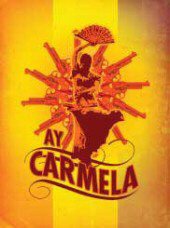
It is therefore excellent news that Trafford has translated and adapted the classic Spanish play, “¡Ay Carmela!” by Josè Sanchis Sinisterra into English. It is currently playing in York, and the
reviews are good. Writing in the British Theatre Guide, Julie Atkinson says, “Sinisterra's two-hander … presented translator Steve Trafford with a challenge: how to do justice to the author's poetic yet colloquial style. Despite not being a fluent Spanish speaker (he freely admits to using a literal translation, a French translation and Spanish and French dictionaries), Trafford succeeds brilliantly. The ear quickly becomes attuned to picking up his clever but unobtrusive use of alliteration and internal rhymes, yet the dialogue never sounds contrived or self-consciously "poetic" - quite an achievement in a work so strongly influenced by the work of Samuel Beckett and the Latin American tradition of magic realism.
“Elizabeth Mansfield, who co-founded Ensemble with Steve Trafford, is ideally cast as Carmela. As well as giving a wonderfully funny and moving performance she also has a thrilling singing voice which is used to the full in several musical numbers. Robert Pickavance gives a tour de force performance as the harassed Paulino, in comparison with whom Basil Fawlty is positively laid-back. The couple perform their flamenco routine with real panache and their interaction, both "on-stage" and behind the scenes, has the easy familiarity born of long experience. It's easy to believe that these two have been working together for years.”


“¡Ay Carmela!” was filmed in 1991 starring Carmen Maura, and concerns the fate of a Republican theatre troupe who stray behind fascist lines during the Spanish Civil War. They are arrested, and fear a firing squad, but they receive a reprieve from an Italian Fascist commander who loves the theatre. He arranges a performance for his troops, bargaining with the actors that they stage a burlesque mocking the republic in exchange for their freedom.

This theme of the relationship of the individual artist to facsism is of course reminiscent of
István Szabó’s brilliant 1981 film, “Mephisto”, but the wider issues of artistic responsibility are also familiar territory for Trafford himself. He was a founder in the 1970’s of the Red Ladder theatre company but now earns his living writing for television. As he says: “We are in a … set of contradictions. Mayakovsky says "All art serves, either as we dream the world can be; or as the world is, contributing to more dust settling on our hopes." You are caught in that trap aren't you? What are you contributing? Attempting through your art to shift and shunt the way in which the world is moving? And artists today I think feel incredibly marginalised by commercial art.”

“A Cloud in Trousers” explored the difficult position of the explosive genius Mayakovsky and his responsibility to continue artistic rebellion even as the walls were closing in on him through Bolshevik conformity. ““¡Ay Carmela!” concerns itself with the closely related dilemma of whether artists should stay true to their beliefs or should bow to pressure and allow their talents to be used to serve reactionary goals.

These are serious questions, Trafford is a brilliant playwright, and the Ensemble company, including the extremely talented Elizabeth Mansfield, are performers of rare ability. It is a joy to see such first class socialist theatre being performed. Make sure you go and support this play.

“¡Ay Carmela!” is showing in York till 30th September, then Darlington, Bolton, Leicester, Farnham, Tunbridge Wells, Frome, Chipping Norton, Beetham, Shepperton, Taunton, Halesworth, London Shaw Theatre (7 to 18 November), Cardiff and Cheltenham.


Worth adding for those in London; The tour will include a gala evening on November 7th, at the start of the London run at the Shaw Theatre, in association with the International Brigade Memorial Trust, celebrating the heroism of men and women from all over the world who volunteered their lives in the fight against fascism.

Friday, September 22, 2006

Make Your Front Popular


Those nice people at Philosophy Football have produced a series of T-shirts to commemorate the Spanish Civil War.

As Mark Perryman says: “We've tried to break with all the sectarian nonsense around this period, whatever our views of the communists or anarchists these were men and women who gave their lives in the fight against fascism so the entire memory should be respected. We're hoping to raise some dosh for the International Brigade Memorial Trust.”

I think Mark is completely correct here. I recently watched that Ken Loach film “Land and Freedom” again and I was a bit weary of the caricature of the CP international brigaders. Not only was it bad history to only show one side of the story, it also reduced the dramatic power. For example the CP are only shown fighting other lefties, there was no hint, for example, of the immense role played by the Russian air force in preventing the fall of Madrid, and the fact that there was real substance to the CP’s argument that only a professionalised army could beat the fascists. In a bizarre twist of history the argument used by Trotsky for a professional army in the Russian Civil War was put forward by the official CP in Spain, while the semi Trotskyists of POUM echoed the position of Stalin’s supporters in the Russian Red Army, that there should be a proletarian militia.

In any event – the civil war was 70 years ago, and much of the historical baggage has simply got to be put to bed.

Philosophy Football have produced these shirts, because in Mark’s own words: “Seventy years ago in 1936 the Spanish Republic were joined by the International Brigade, thousands anti-fascist volunteers from around the world, in the battle for land and freedom. Their foe, Franco and his Fascists were backed by Hitler and Mussolini while the British and other governments shamefully hid behind so-called 'Non aggression' to starve the Republicans of supplies and munitions. The battle cry of the Republic was No Pasaran , 'They shall not pass', the heroism, solidarity and sacrifice in the face of Franco's overwhelming force has inspired anti-fascists ever since.”

The four shirts depict different forces united in Spain's battle. The flag of the Left Party of Catalonia, the Catalonians like the Galicians and Basques recognised the need to unite behind the Republic against Franco. The banner of the Tom Mann Centuria, formed by British volunteers in Barcelona this unit went on to become the basis of the British Battalion of the International Brigade. Tom Mann was a militant trade unionist and founder of the Communist Party of Great Britain. The banner of the POUM militia, the unit with which George Orwell famously served. And the banner of the anarcho-syndicalist CNT-FAI, critics of the Popular Front government but allies in the fight against fascism.

Apparently sales have been going very well, and people have been buying combinations of shirts in an encouragingly non-sectarian way. Although I am pleased to report that the Tom Mann shirt is the most popular!


Thursday, September 21, 2006

This Country Life

....

Last Saturday I debated “rural affairs” with North Swindon MP, Michael Wills, and Tory candidate Justin Tomlinson. This all came about because during the last general election some fox hunting supporters campaigned for Justin, as Wills is a firm supporter of the ban on hunting with dogs. Justin apparently insisted that if he was going to debate then I should be included – I don’t think this is entirely due to his admiration for my political debating skill, but because I usually give Wills a hard time. Wills then insisted that if I was going to be there, then the loony toons candidates for UKIP and a pensioner who campaigns against money should be on the platform as well. (I know some of you are thinking aren’t I also a loony toon – but you have to hear these guys!).

I had the invite in May, but never received any reminder. There would be two schools of thought about this, either Michael’s secretary remembered to invite the other candidates but forgot about me, or he didn’t want me there. The North Swindon constituency actually has a largish rural component, but in best New Labour form, Michael had organised the meeting in the heart of the town.

Anyway, there we were discussing rural affairs, being chaired by Nick Bent from the National Farmers Union, in front of about 40 people - many of the Labour and Tory activists. Strangely it turned out I was the only panellist from a rural background, and the only panellist to have been hunting. Before you start imagining me dressed in a red (or more technically pink) coat and downing a stirrup cup, I used to keep whippets and hunt rabbits with them.

I really am not very fond of these debates that are dominated by a single issue, because it raises the temperature, and neither side seem particularly interested in listening to the arguments.

Anyway, the discussion on rural housing was quite interesting, I told anecdotes of friends of mine whose families have been 600 years in the same village but now cannot afford to live there as the picturesque houses have been bought up by TV producers and stock brokers as weekend retreats. There was widespread support in the meeting for my view that there should be a change in planning law that meant people should need to apply for a change of use if they want a second home, and that there should be a presumption towards refusal. I also argued against the current ban on councils building council houses. Of course Michael Wills tried to weasel his way round that one by saying there was no ban on building council houses – this is technically true, but they are not allowed to fund building council houses in a cost effective way. And in any event the Registered Social Landlords (Housing Associations) are not being funded to pick up the shortfall.

How the crisis has come about is largely due to the Tory policy (continued by Labour) of discounted right to buy of rural council stock and the Tory policy (continued by Labour) of deregulated public transport, which has meant no effective bus service. There is now noaffordable housing for people who work in the country, and a disruption of family life as young people are forced to move away. Specific policies, such as removing some of the profitable services that kept rural sub-post offices going, or banning smoking in pubs that will no doubt see many rural pubs close, have even further hollowed out rural communities to becoming commuter dormitories.

What is more, in reality rural policy is decided more by the Supermarket chains than government, so we seen a disastrous fall in many farm incomes, particularly fruit and milk producers, as these products are often bought below their cost of production, as their is only a single buyer. While at the same time the centralised distribution networks drive food all over the country before it hits the shelves. Worse still is the incredible levels of wastage – only something like 20% of potatoes grown in the UK ever reach a plate, as most of them are rejected by the Supermarket buyers as being too small, too big, too blemished, too knobbly, etc. Similar levels of waste effect fruit and other products.

Part of the trouble with the debate was that both Wills and Tomlinson agreed with all these specific points, but the solution lies outside that available for market mechanisms. The Supermarket chains are acting rationally in the interests of their shareholders, and - in so far as people keep buying stuff from them – they could argue in the interests of their customers.

The solution lies in strong government intervention, including nationalisation and state control of the supermarkets. You cannot blame a wolf for being a wolf. They have too be given a different goal – not profitability - but healthy food and a sustainable rural economy. To take food distribution out of the market and profit drive requires social ownership.

All our food could be cheaper if we were prepared to buy – for example - carrots that were not all exactly the same length and smooth and straight. That is only achieved by throwing away more than half the crop. This needs people to become educated about food, growing fruit and vegetables at school, rearing and killing animals for food, every child given a free nutritious school meal from local produce, and there needs to be a ban on junk food advertising. Councils should also be given central government funding incentives to provide sufficient support for allotment holders in towns.

The animal rights debate was a bit tedious. I condemned the way the Countryside Alliance has sought to hijack the very real social problems in the country behind their sad and sorry single issue. I know of two tractor drivers personally opposed to hunting who were made by the employers to go on the Countryside Alliance march or lose their jobs. There is also much more invidious social pressure towards conformity in the country, which means that the pro-fox hunting lobby manages to present itself as the voice of the country, despite the fact that most rural people don’t support it. Not least because the hunts are snobby, elitist, and bad neighbours – spooking other peoples’ livestock and leaving gates open.

But equally, some of the anti hunting campaigners (and there are exceptions) don’t give a fig about any of the real issues in the country. I am sure being caught by the hounds is terrible for the fox, but otherwise most of them die a slow horrible death of starvation and disease anyway. And the ban also extends to coursing, which involves a quick clean death for the rabbit or hare, and they can be eaten afterwards. In fact the strongest argument against the ban is what will be next? If hounds are banned then is it ferrets next, and then shooting, and then falconry, and then fishing? Hunting is the largest participatory sport in the country, with something between 4 and 5 million regularly involved.

I have a great deal of respect for animal welfare campaigners, and for political vegetarianism. But at the same time the ban on hunting has not been won on the basis of an informed and consistent policy towards animal welfare. Battery chicken and factory pig production are by far the biggest animal welfare scandals. The aversion to hunting is at least partly due to a townie alienation of the actual reality of living and working with animals.

Tuesday, September 19, 2006

FAIRFORD DISARMERS - MISTRIAL CALLED


A judge at Bristol Crown Court has ordered a re-trial in the case of two peace activists charged with damaging military equipment to stop planes taking off. After a day and a half of debate, the jury failed to reach any clear verdict.Paul Milling and Margaret Jones are charged with conspiracy to commit criminal damage after disabling several dozen bomb carrying and fuel vehicles at RAF Fairford in March 2003. They were attempting to hinder take-off of 14 B-52 planes to bomb Iraq at the start of the 2003 invasion. Milling and Jones say this was a bid to delay the planes’ departure for Baghdad and give more people time to flee the city – thus protecting property and helping to prevent war crime.

In a prepared statement handed in when they were arrested at RAF Fairford after damaging two dozen vehicles, they wrote of the air base as ‘a launching pad for war crimes’, adding that if they could save ‘one life’ by their actions, they would consider them justified.

Bruce Houlder for the prosecution alleged the defendants ‘claimed a charter’ to act without reference to the law. If the defendants’ actions were taken to their logical conclusions, he told the jury at Bristol Crown Court, ‘one might as well tear up the laws of this country.’

This was ‘a unique case’ said Hugo Charlton, defending Margaret Jones. The law allowed for exceptional circumstances, and the threat to life in Iraq posed by the bombers at Fairford was one such situation. The burden of proof, he said, was ‘on the prosecution’. It was not necessary for the defendants to have been engaged in actually ‘stopping’ a crime. It was enough that they were seeking to ‘prevent’ it, and that they honestly believed that homes and property in Baghdad were in need of protection.

James Hines, representing Paul Milling, denied that the action taken was merely a symbolic ‘protest’. The defendants acted reasonably, he said, in the light of everything they had read and heard before the start of the war. Reminding the jury that the region now devastated by war is one of the cradles of civilisation, he asked them to imagine how they would react if 30 missiles, or even three, landed on their own city. He accepted that it was difficult for Westerners leading safe lives to imagine an existence where people struggle to survive without electricity or water, among unexploded cluster bombs, with sudden death an ever-present reality. These, he said, were conditions the defendants had been able to picture, and that they had done their best to address. Theirs had been a genuine attempt to save life.

During the previous week the court heard moving testimony from those who were in Baghdad during the bombing, including a young Iraq man who survived the cluster bombing of a residential area.
Phil Pritchard and Toby Olditch start their trial on Monday the 2nd of October (9.30 am at Bristol Crown Court). Charged with conspiracy to commit criminal damage for trying to reach and disable a B-52 bomber at Fairford. Please come and show solidarity.

Where are the good left blogs?

Dave Osler’s blog seems to be going from strength to strength. Recently highlighted by Channel 4’s web-page as one of the 20 most influential political blogs in Britain, and selected as #8 of pro-Labour (in the wider sense?) by Top Tory Blogger, Iain Dale.

Naturally all of us who blog are secretly motivated – at least partially - by vanity, so Dave naturally posted a piece about this on his blog, where he makes the following point: “Not bad going for six months’ work. Readership figures are picking up, boosted by the brilliant redesign courtesy of Will. And a few of the more leftist national newspaper journos and Westminster researchers are starting to email goss in to blues.power@virgin.net.But wouldn’t it be good to have a far left website that has the same sort of clout as Guido and Dale do on the right? For that, I need more inside track stuff. My hero Paul Foot always used to include an appeal to readers for information in his classic Daily Mirror columns. I’d love to continue that tradition.”

So obviously it would be good if people took Dave up on this, and helped him develop his blog in that direction. But why is there no really good left blog? This seems to me partly a reflection of how marginal the left is on British politics. There is also the widespread use of printed media by the political left that make some blogging redundant, it has occurred to me for a while that you could produce a very good blog just by reading the Morning Star! But the left has also developed a culture of privacy, for example all sorts of interesting information comes our way in the Socialist Unity Network on the basis that it is kept confidential.

Dave is running a poll on his site on what is the “second best leftwing blog in Britain”. When you look down the list of Dave’s candidates, well you cannot help think, yeah, but is that the best we can do?

Stroppyblog has become popular very fast. Not surprising as it is updated regularly, is informal and occasionally very funny. There are also some serious well researched pieces.

The General Theory of Rubbish is a bit terse and cryptic. Although well designed and regularly updated, it is a bit too idiosyncratic for my liking.

Shiraz Socialist. Seems to be mainly reaction pieces, from an AWL type perspective, to stuff going on. Well, if you like that sort of thing. … …

JBlog is a rather more serious effort from Janine Booth, also of the AWL. Well worth a regular look.

Gauche There is a lot of chaff, but some good wheat amongst it. Particularly useful is the archive links, allowing you to jump directly to the best posts from the past, organised by subject.

Random Pottins really is a great blog. Informative, and covering a diverse range of subjects. Particularly astute when covering Israel, Palestine and Zionism.

Normblog. Many years ago Norman Geras wrote a well received book about Marx and human nature. I could never be bothered to read it. He has developed an immensely self-satisfied bloated ego. The main point of the blog seems to be to eruditely explain that we are all stupid for opposing US foreign policy. Oh, and to remind us how immensely clever Professor Geras is.

Harry’s Place. Ahh bless. Imagine Norman Geras bitten by a rabid Dog. Harry’s place is home of “decency”. In the old days decency used to mean, well, being decent. Nowadays it means support for neo-colonialism, islamaphobia, and vitriolic distain for the hard left. The most remarkable thing about Harry’s place is the comments, where racist comments are not criticised, but leftist comments critical of the Harry team are sometimes altered. A shrill, nasty experience, best avoided.

Lenin’s Tomb. The unofficial official SWP blog. Written by verbose twenty somethings full of outrage at the world, and an uncomplicated faith that there are goodies and baddies. Actually this is its strength, and the Tomb is guaranteed to be entertaining, informative and committed. “Lenin” himself rather remarkably rejects the Marxist method, arguing that there is no underlying objective reality, and all that really exists is language. (This presumably makes it easier for him to support Tommy Sheridan). Worth checking occasionally, but the comments can become depressingly sectarian.

Dead Men Left. Another good SWP blog, but updated less frequently than Lenin’s Tomb, and a little more measured. Worth looking at regularly.

Drink Soaked Trots. If you like the General Theory of Rubbish, you will like this collective blog. Much too much space spent slagging of the left for my liking.

Socialist Unity Blog. Sister to the Socialist Unity Network site. The origin of our main website was that we felt there was a gap in the market for a left wing publication that promoted a serious discussion about the way forward for the left, that was not banging the drum for any particular organisation, and was open to different voices. The Socialist Unity Blog was started as a way of being a bit more interactive, and also a place for some more quirky pieces. If you like the blog, you should regularly check the web-site as well.

It is worth saying there are some other good leftie blogs from this island, and had I been doing a poll instead of Osler these might have made the cut: International Rooksbyism, Daily (Maybe), The Point Is Liam Mac Uaid, Matthew Sellwood , Kevin Williamson

Oh yeah, and now go and vote for the Socialist Unity blog in the poll on Dave Osler’s blog!

Monday, September 18, 2006

Set back in Germany


Bad result in Berlin's state election this weekend. (sorry for any inaccuracies in translating German to English - I am a little rusty) Note also that criticism in this posting about the Greens is specific to the German incarnation, which is increasingly right wing.

SPD (New Labour) 30,8%
CDU (Tory) 21,3%
Linke (real socialists) 13,4%
Grüne (right wing greens) 13,1%
FDP (more Tories) 7,6%

Remember that the PDS. die Linke have been just under 17% for several years, and their leader Gysi got 22% first preference last year. The PDS are a remarkable party, with around 68000 members, that they have rescued from the wreckage of the old ruling communist, SED. Remember that the SED had 2 million members, so the PDS membership is only that part who are really committed to socialism, and of course many new younger people have joined with no links to the old DDR state. PDS leader Gregor Gysi was a dissident in the old DDR, so the party embodies the progressive aspects of the DDR, and not the repressive parts.

The drop in their result is largely being blamed in the German press on the WASG standing against them in Berlin, Lucy Redler (SAV -CWI, affilate of the Socialist Party in England - formerly the Militant) got 3%, under the 5% hurdle to get into the state parliament. (Bear in mind that this 3% was not under the banner of the SAV itself, but standing as the WASG, a mainstream mass party already represented in parliamant, so it was an especially bad result for Redler)

The WASG are an important split from the SPD, led by former party big hitter (Think Tony Benn, if he had actually won the deputy leadrer election), with 10000 members, mainly in the West, and who did extremely well in last years eletion, particularly in the industrial belt of the Saarland (equivalent to Labour heartlands in North East England). Between them the PDS and WASG have 54 members of parliament

There is also already some self criticism that this set back may be due to their coalition with the SPD. Linkspartei-Bundesgeschäftsführer Dietmar Bartsch hat inzwischen eine "selbstkritische Analyse" in Aussicht gestellt. Die Wähler hätten die Linkspartei für ihre Arbeit im rot-roten Senat der Bundeshauptstadt "schwer bestraft", sagte Bartsch in der ARD. (The voters have severley punished the Links Partei for ther work in the red-red senate of the capital city, said Linkes Partie national secretary Dietmar Bartsch. )

The PDS have followed a “dented shield” policy of seeking to pull the SPD (Labour) to the left, and opposed as far as possible neo-liberalism. The following web broadcast is only in German, but is a good explanation of the PDS position. (In particular there have been difficult decisions, due to the low level of confidene in the working class for struggle,). The CWI make a lot of mileage about events at the Charité hospital, which the SPD wanted to privatise. In order to prevent privatisation, a reduction in service and a bonfire of workers rights, the PDS have worked with the unions to see there are ways of reducing the wage bill, to keep the service open and in public ownership. Obviously it would be better if the unions would fight and a campign could defend both the current wages, and the social ownership. But in reality there is no mood for a fight, there is much much less mood for a fight than when the Militant called off action in Liverpool. Sometimes you have to bend so you don't break.

Here is the rather shrill web broadcast by the CWI member, Lucy Redler. (unfortunately also only in German). the WASG stood against the PDS, against the wishes of the WASG party nationally, as this damages the prospects of fusion between the WASG and PDS next year (due to some federal legislation). The CWI have (yet again!) put narrow self-interest before the bigger picture of strengthening the whole socialist movement. The Greens are completely right wing, ambiguoss on the war on terror and embrace neo-liberalism The up shot is that there is likely to be a red-green coalition (SPD-Green), committed to neo-liberalism and privatisation. Thanks CWI !!!

REACTIONS:
Gregor Gysi, Linkspartei: "Das ist eine bittere Niederlage für uns in Berlin.Die Grünen sind hier so geil und scharf aufs Mitregieren, dass es mir schon ganz unheimlich ist." Gysi: "This is a bitter blow for us in Belin, the Greens here are so venal and focussed towards coallition government, that to me is completley obvious"

Petra Pau, Linkspartei: "Wir haben unser Ziel 17 plus X deutlich verfehlt. Es wird zu entscheiden sein, mit wem die SPD regieren wird." Pau: We have clearly failed to reach our goal of 17 plus per cent, it remains to be seen who will rule with the SPD"

Claudia Roth, Die Grünen: "Ein unglaublich tolles Ergebnis! Es gibt in Berlin einen Wahlgewinner – und das sind die Grünen. Ein eindeutiges Votum der Berliner für Rot-Grün in dieser Stadt. Und das mit Betonung auf Grün." Roth (Green). An unbelievably good result. In Berlin there was an election winner, and that is the greens. A doubtless vote for a Red-green coalition in this city, and that with the emphasis on the Greens"

Gysi sagt, die klare Erkenntnis dieser Wahl sei, dass es der Linkspartei und der WASG gleichermaßen schade, wenn sie gegeneinander antreten. "Die WASG kommt ohne uns nicht ins Parlament und wir verlieren unnötig drei Prozent." Gysi said that the clear realisation of this election was that the PDS and WASG are both damaged of the stand against each other. "The WASG wouldn't be in parliament without us, and we unnecessarily lost 3%"

OUTSIDE BERLIN: Really bad in Mecklenburg Vorpommern, where the nazi NPD got over 38% across one whole town, and after the election there was a savage attack on PDS members, the press reporting it was a marvel no one killed.